Chappell Roan’s 2025 GRAMMY outfit was far more than a colorful red-carpet dress. For her first GRAMMY Awards appearance, the singer chose an archival Jean Paul Gaultier couture design that combined ballet imagery, fine art, theatrical styling, and the exaggerated proportions that have become central to her public fashion identity.
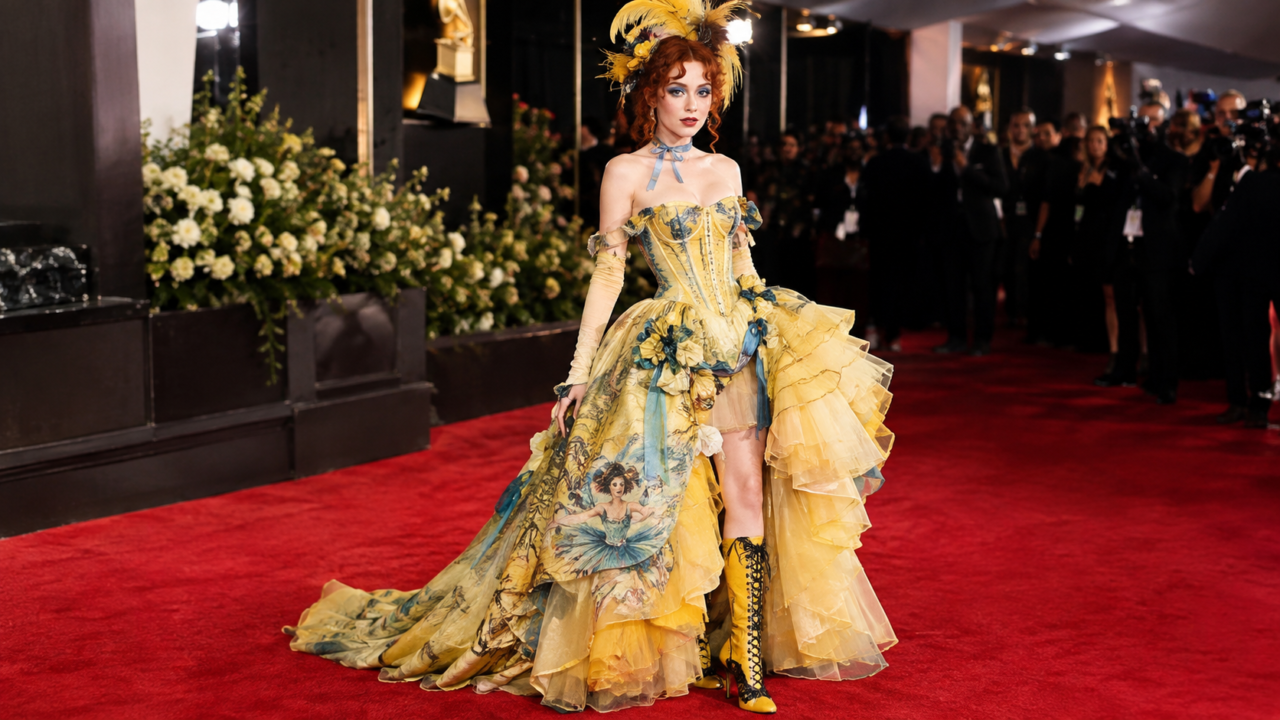
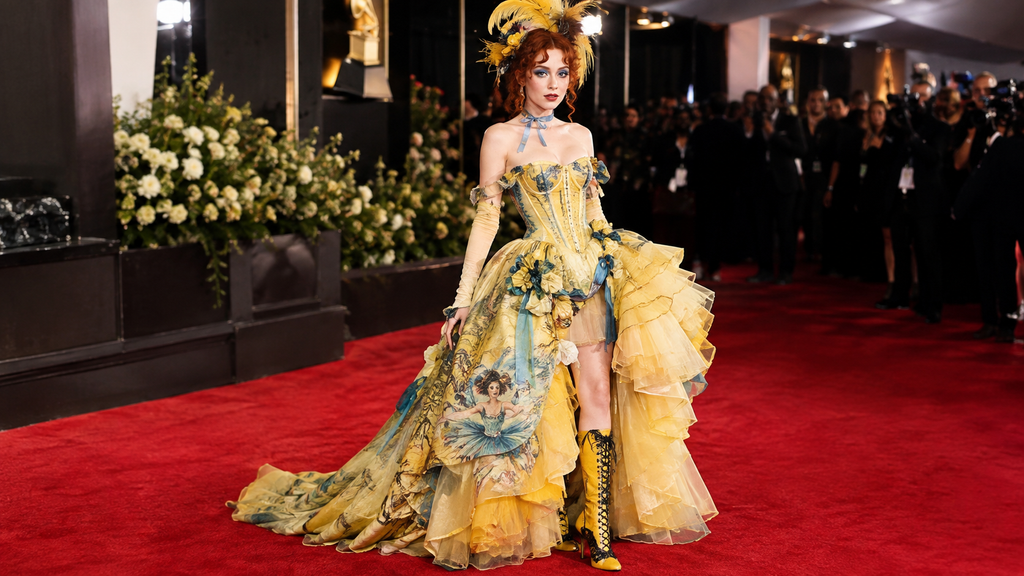
The look came from Jean Paul Gaultier’s Spring 2003 couture collection and featured imagery connected to French Impressionist artist Edgar Degas. Roan worked with stylist Genesis Webb on the appearance, adding a dramatic feathered headpiece, matching gloves, a blue ribbon choker, and customized footwear. Vogue described the overall approach as a distinctive interpretation of balletcore rather than a conventional formal-gown moment.
The choice was especially significant because the 2025 GRAMMYs marked a major moment in Roan’s career. She was nominated in six categories and ultimately won Best New Artist.
Here is a closer look at the Chappell Roan Grammy outfit, the design history behind it, and the fashion ideas that made the appearance so memorable.
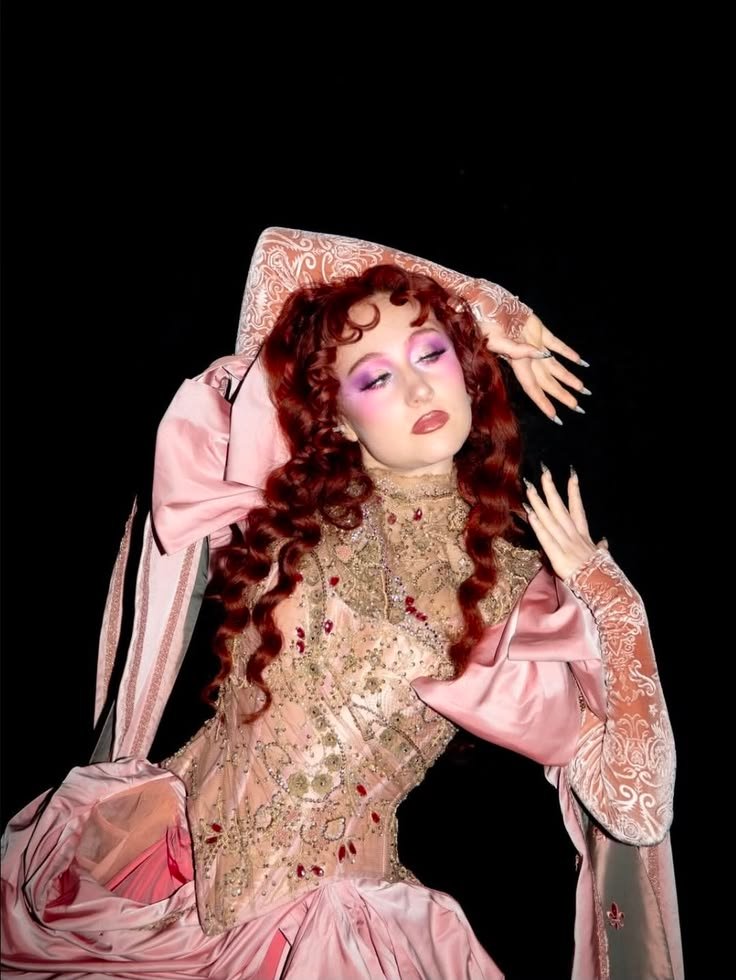
Chappell Roan’s 2025 GRAMMY Outfit at a Glance
The main red-carpet outfit was a vintage Jean Paul Gaultier couture look from Spring 2003.
Instead of choosing a simple modern evening gown, Roan stepped into an archival piece filled with theatrical references. The dress used a predominantly yellow palette with blue and other colorful details, while its skirt incorporated imagery of ballerinas associated with Degas.
The garment was originally presented as part of Gaultier’s Spring 2003 couture collection. Roan’s version was styled specifically for her GRAMMY appearance, meaning the archival garment was not simply worn exactly as it appeared on the original runway. Elements were adapted and coordinated with contemporary accessories and beauty styling.
The result was unusual for a major music awards ceremony because the outfit functioned almost like a small theatrical production.
There was a recognizable character behind it.
There was an artistic reference.
There was a historical fashion element.
And there was enough visual drama to make the outfit work on a red carpet rather than looking like an ordinary vintage revival.
GRAMMY.com specifically highlighted the Degas connection, describing Roan’s dress as a frilly yellow 2003 Jean Paul Gaultier couture design featuring the French artist’s iconic ballerinas.
That combination helps explain why searches for the Chappell Roan Grammy outfit continue to focus on this particular appearance.
The Jean Paul Gaultier Couture Behind the Look
Jean Paul Gaultier has a long history of treating clothing as a form of visual storytelling. His work frequently plays with proportion, cultural references, historical clothing, theatricality, and the relationship between the body and the garment.
Roan’s GRAMMY dress fits naturally into that design language.
The dress came from Gaultier’s Spring 2003 couture collection and was originally associated with runway styling that emphasized its elaborate surface, color, and movement. Vogue identified it as a look modeled by Mariacarla Boscono.
Using an archival couture piece for a major contemporary red carpet creates an interesting dialogue between two periods.
The garment belongs to the early 2000s.
The artist wearing it belongs to a much newer generation of pop culture.
Instead of treating the older piece as something frozen in fashion history, Roan’s styling allowed it to become part of her current visual language.
That is one reason archival fashion has become increasingly important in celebrity dressing. A vintage runway garment can bring a story that a newly produced dress does not automatically possess.
A designer can create a beautiful new gown, but an archival piece can carry a previous chapter of fashion history with it.
Roan’s choice therefore worked on two levels: it was visually striking for the red carpet, but it also rewarded viewers who recognized the reference.
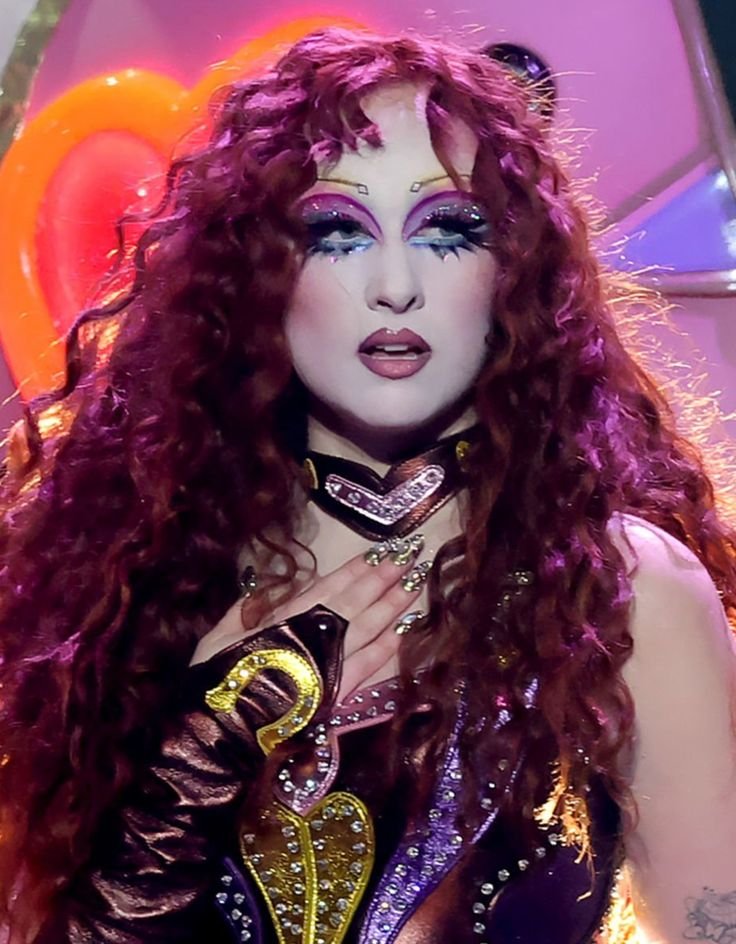
How Edgar Degas Became Part of the Dress
One of the most distinctive elements of the Chappell Roan Grammy outfit is its relationship with Edgar Degas.
Degas was a French Impressionist artist particularly associated with paintings, drawings, and sculptures depicting dancers. His repeated studies of ballet performers captured movement, rehearsal, posture, clothing, and backstage life.
That artistic vocabulary is particularly appropriate for a performer.
Roan’s dress incorporated imagery of ballerinas, creating a visual connection between the singer and the world of performance. GRAMMY.com specifically noted that the dress channels Degas through its ballerina imagery.
Vogue went further, connecting the outfit to Degas’s Dancer with a Bouquet. The publication described the look as an unconventional take on balletcore and noted that the dress featured an asymmetrical skirt with a print of Degas’s ballerinas.
This is an important distinction.
The outfit was not simply “a ballet dress.”
It used ballet as an artistic reference.
That difference matters because ballet-inspired fashion can easily become predictable. Tulle skirts, ballet flats, ribbons, pale pink colors, and soft silhouettes are familiar visual shorthand.
Gaultier’s approach was much less literal.
The dress brought together the delicacy of ballet imagery with a highly constructed couture garment. The contrast created tension between softness and theatricality.
That tension is also central to Roan’s fashion persona.
Breaking Down the Outfit’s Design
Color and visual movement
Yellow immediately establishes the dress as a high-impact red-carpet piece.
Yellow is visually energetic, especially under strong event lighting and photography. Rather than relying on a dark evening palette, the outfit uses brightness as part of its identity.
Blue accents introduce contrast, while additional floral and berry-like details add complexity to the surface.
The color arrangement also prevents the dress from reading as a single flat block of yellow.
Instead, the eye moves around the garment.
This is particularly useful for a couture piece photographed from multiple angles. A successful red-carpet design needs to work while standing still, walking, posing, and appearing in photographs.
Roan’s outfit had enough variation in color and texture to maintain visual interest from different viewpoints.
Silhouette and proportions
The silhouette is another reason the dress works so effectively.
Rather than following the streamlined column-gown formula common on formal red carpets, the outfit uses volume and asymmetry.
The skirt creates movement around the lower body, while the upper portion provides a more controlled structure.
This creates a strong proportion relationship.
A large skirt needs visual balance above it. If every element of the outfit is equally oversized, the silhouette can lose its focal point.
Here, the structured bodice and dramatic skirt work together to establish a recognizable shape.
The asymmetric quality adds another layer.
Symmetrical gowns often create a sense of formal perfection. Asymmetry introduces movement and theatrical irregularity.
That choice suits Roan because her red-carpet wardrobe frequently favors clothing that looks like a character has stepped out of a performance rather than a standard celebrity styling package. Vogue has described her wider fashion image as campy, drag-inspired, and heavily connected to pop-cultural references.
The headpiece
The headpiece was essential rather than decorative.
Roan wore a dramatic feathered headpiece incorporating colors that related to the dress. Vogue notes that the original runway headpiece was retained as part of the styling.
That decision strengthens the historical connection.
Instead of taking the dress and replacing all of its original visual language with contemporary accessories, the styling preserved an important part of its original identity.
The headpiece also extends the vertical line of the outfit.
The eye travels from Roan’s red hair upward into the feathered structure, creating a larger silhouette around the head and shoulders.
On a red carpet, this kind of proportion can be useful because photographs often crop the lower part of a garment. A strong headpiece ensures that the outfit remains recognizable even in closer images.
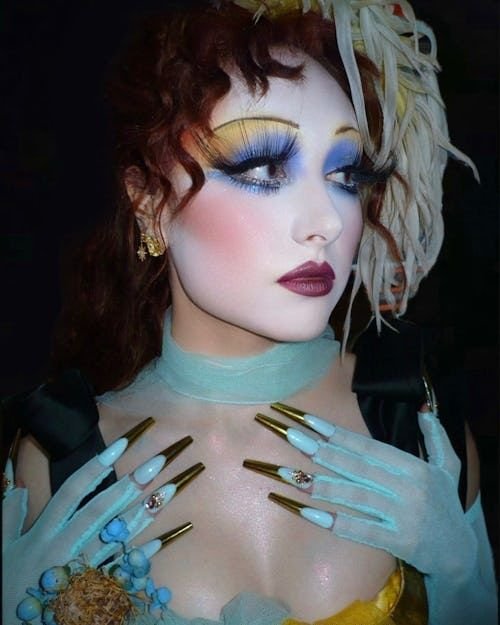
Gloves, choker and footwear
The accessories were carefully connected to the main garment.
Roan added fingerless opera gloves and a blue ribbon choker, creating a visual bridge between the dress’s blue details and her styling. She also wore yellow-and-black boots with turquoise accents instead of simply reproducing the original footwear.
This is a useful styling lesson.
When working with an archival garment, the goal does not always have to be perfect historical recreation.
A better approach can be to preserve the defining elements while making selective changes for the person wearing it.
The gloves emphasize the hands and arms.
The ribbon brings attention to the neck.
The boots introduce a stronger contemporary attitude.
Together, those details prevent the look from becoming a costume reproduction.
Why the Archival Choice Worked for Chappell Roan
The strongest part of this outfit is the relationship between the garment and the person wearing it.
An archival piece can look disconnected from a celebrity when the styling feels forced. That was less of an issue here because Roan’s public image already incorporates theatricality, exaggerated beauty, historical references, and camp aesthetics.
Her fashion is often designed around transformation.
Vogue’s coverage of her style has highlighted collaborations involving designers such as Thom Browne, Rodarte, Mugler, and other craftspeople. The publication has also pointed to her use of elaborate character-based styling across performances and red carpets.
That context makes the Gaultier dress feel coherent.
It is dramatic, but drama is already part of Roan’s fashion vocabulary.
It is referential, but references are already central to her image.
It is theatrical, but she is a performing artist.
And it has an element of camp, which fits the exaggerated proportions and playful visual language.
This is an important principle in celebrity styling: the strongest statement outfits often feel like an extension of the wearer’s established visual identity.
The Other Chappell Roan Looks at the 2025 GRAMMYs
Searching for the “Chappell Roan Grammy outfit” can be confusing because she did not wear only one outfit during the 2025 ceremony.
Her evening included several distinct looks.
The red-carpet appearance was the archival Jean Paul Gaultier couture dress.
After arriving at the venue, Roan changed into a blue corseted gown. ELLE reported that she wore the second look inside the ceremony.
She also performed “Pink Pony Club” in a separate custom look. GRAMMY.com’s coverage describes the performance styling as a black-and-gold rhinestone corset, black leather gloves, and a black bedazzled cowboy hat.
The performance look moved away from ballet imagery and toward Western theatricality.
That change is significant because it shows how Roan used clothing to separate different parts of the evening.
The red carpet introduced an art-and-couture narrative.
The performance moved into the world of the “Pink Pony Club.”
Her award-acceptance styling then provided another visual change.
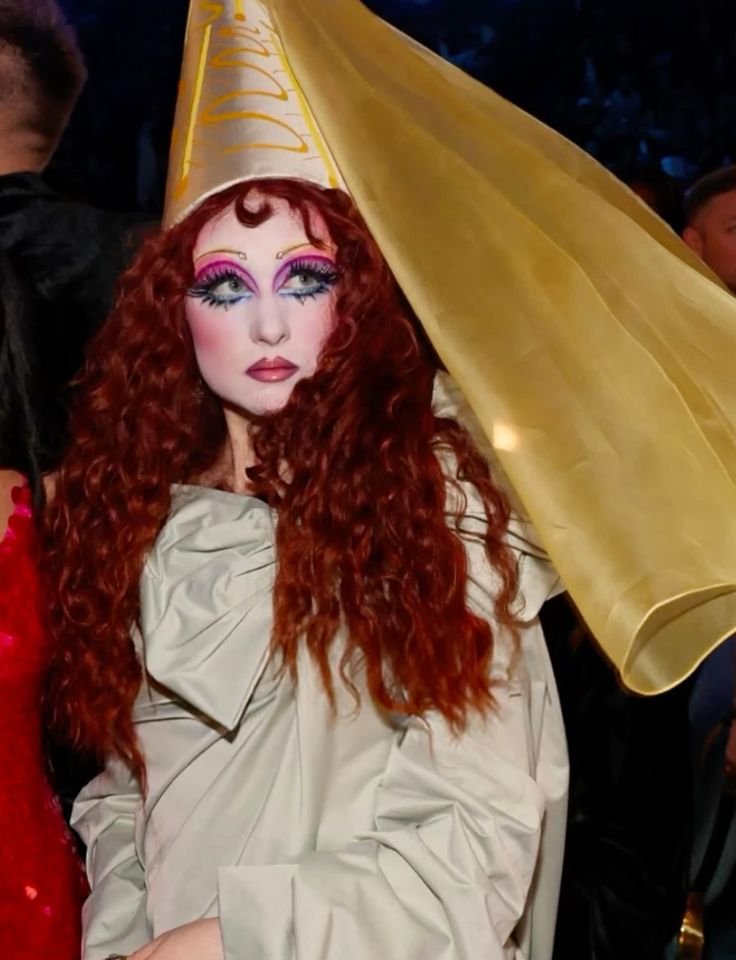
Fashion coverage also documented an Acne Studios look paired with a yellow cone-shaped hat for her Best New Artist acceptance.
So, if a reader sees several photographs from the 2025 GRAMMYs and notices that Roan is wearing different clothes, that is not a contradiction.
She deliberately moved through multiple fashion identities during the evening.
What This Outfit Says About Modern Red-Carpet Fashion
Roan’s GRAMMY appearance illustrates how red-carpet dressing has changed.
For many years, the conventional awards-show formula centered around a beautiful new gown, luxury jewelry, carefully styled hair, and polished beauty.
That approach still exists.
But contemporary celebrity fashion increasingly allows clothing to function as narrative.
A garment can reference an artist.
It can revive an archival collection.
It can establish a fictional character.
It can communicate an era.
It can connect music and visual art.
Roan’s Gaultier look does all of these things simultaneously.
The outfit is therefore interesting from a fashion-design perspective because the value does not come only from its color or silhouette.
The reference system behind the garment gives it additional meaning.
The viewer who simply sees a colorful couture dress gets one experience.
A viewer who recognizes Gaultier gets another.
A viewer who recognizes the Degas reference receives another layer.
Someone familiar with Roan’s wider visual identity can see how the look fits into her ongoing approach to performance and transformation.
That is the power of fashion storytelling.
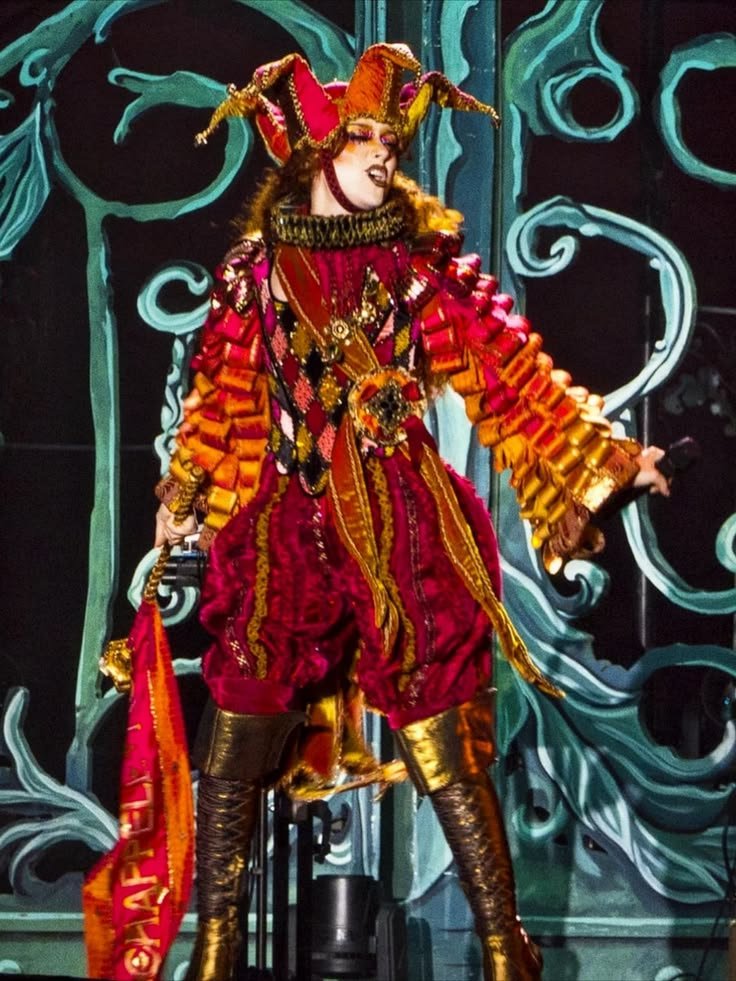
How to Take Inspiration From the Look Without Copying It
You do not need couture or a celebrity stylist to borrow the design principles behind Roan’s outfit.
The easiest lesson is to focus on one strong reference.
For example, instead of recreating the entire look, you could build an outfit around ballet-inspired details:
- A structured bodice with a softer skirt
- A ribbon detail at the neckline
- Gloves for evening styling
- A dramatic hair accessory
- A vintage-inspired print
- A statement color such as butter yellow
- A pair of contrasting boots
The important thing is proportion.
If the clothing already has volume, keep some accessories controlled.
If the dress has a complicated print, choose simpler jewelry.
If the shoes are dramatic, avoid adding too many competing details elsewhere.
Roan’s look works because the individual components belong to the same visual story.
Use art as a styling reference
Another useful idea is to start with an artwork rather than a fashion trend.
Choose a painting, photograph, sculpture, film, or historical period.
Then identify three things from the reference:
Color: What colors dominate?
Shape: What silhouettes or gestures stand out?
Texture: What surfaces or materials appear?
You can then translate those characteristics into contemporary clothing.
This creates a more personal result than simply searching for “trending outfit ideas.”
Mix historical and contemporary elements
Roan’s styling also demonstrates that vintage-inspired fashion does not need to look completely historical.
A modern boot, contemporary makeup, or updated hairstyle can shift the balance.
For everyday dressing, this might mean combining a vintage blouse with modern wide-leg trousers or wearing a historical-inspired corset with a simple contemporary skirt.
The contrast is often more interesting than a complete period recreation.
Chappell Roan’s Grammy Style in the Context of Her Fashion Identity
The 2025 GRAMMY outfit did not appear in isolation.
Roan had already developed a recognizable visual identity built around theatrical transformation.
Her stage and red-carpet wardrobes frequently incorporate exaggerated silhouettes, historical references, unusual accessories, colorful beauty looks, and elements associated with drag and performance culture. Vogue’s retrospective of her fashion specifically discusses the role of stylist Genesis Webb and collaborations with multiple designers and artisans.
Her first GRAMMY appearance therefore offered an unusually large stage for that approach.
The awards ceremony was not simply another performance.
It was one of the biggest public fashion moments of her career at that point.
The choice of Gaultier made sense because the designer’s work has a long association with challenging conventional ideas of glamour and the body.
The Degas reference added another cultural layer.
And the dramatic styling made the outfit immediately recognizable.
Roan’s fashion identity is particularly interesting because her clothing often refuses to separate music from visual presentation.
The outfit is part of the performance.
The makeup is part of the character.
The hair is part of the silhouette.
The accessories contribute to the narrative.
This makes her red-carpet appearances useful case studies for anyone interested in fashion communication.
The Difference Between a Red-Carpet Dress and a Fashion Image
A technically beautiful dress is not automatically a memorable fashion image.
A memorable image usually has a clear point of view.
Roan’s 2025 GRAMMY look had several identifiable visual anchors:
The yellow couture dress
This immediately establishes the color story.
The Degas ballerinas
They provide the artistic reference.
The feathered headpiece
It expands the silhouette and reinforces the theatrical mood.
The red hair
It creates another strong color relationship against the yellow and blue.
The gloves and ribbon
They connect smaller details to the larger outfit.
These elements work together rather than competing randomly.
That is an important distinction for fashion students and content creators.
Good styling is not simply about adding more.
It is about deciding what deserves attention.
Why the Outfit Still Matters in Fashion Discussions
The Chappell Roan Grammy outfit remains relevant because it demonstrates several ideas that continue to influence celebrity fashion.
First, archival fashion can be culturally useful rather than merely nostalgic.
Second, fine-art references can give a celebrity outfit additional depth.
Third, theatrical dressing can coexist with high fashion.
Fourth, a red-carpet look can communicate personality without relying on a conventional “pretty dress” formula.
And finally, styling can create a bridge between fashion history and current popular culture.
The 2025 GRAMMYs also became a significant career moment for Roan. She won Best New Artist, and the official GRAMMY record confirms the award alongside her other nominations.
That context matters because the outfit was not worn for an ordinary promotional appearance.
It accompanied a major milestone.
The fashion and the career moment therefore became connected in the public memory.
A Note About Chappell Roan’s 2026 GRAMMY Outfit
Readers searching for the phrase today may also encounter coverage of Roan’s 2026 GRAMMY outfit.
That was a completely different look.
At the 2026 GRAMMYs, Roan wore a custom Mugler ensemble inspired by Mugler’s Spring/Summer 1998 Jeu de Paume couture collection. GRAMMY.com described the outfit as involving a ruby-red sheer design, nipple-ring elements, pastie prosthetics, and medieval-inspired temporary tattoos.
Vogue likewise reported that her 2026 red-carpet appearance involved a wine-red custom Mugler look with sheer construction and a matching hooded robe.
This distinction is useful for SEO and for readers.
If someone searches “Chappell Roan Grammy outfit” without a year, the phrase can now refer to more than one GRAMMY appearance.
The 2025 outfit is the yellow Jean Paul Gaultier couture look associated with Degas and ballet imagery.
The 2026 outfit is the red Mugler archival-inspired look.
For readers interested in the most widely documented 2025 fashion moment, the Jean Paul Gaultier dress is the key look to know.
What Fashion Designers Can Learn From the Look
The outfit also offers useful lessons beyond celebrity styling.
Reference can be stronger than decoration
The Degas imagery gives the garment a conceptual foundation.
A designer does not necessarily need dozens of decorative details if one strong reference can organize the entire design.
Contrast creates interest
The dress combines ballet delicacy with Gaultier’s more provocative couture vocabulary.
Softness and structure can coexist.
Proportion communicates personality
The larger-than-life silhouette would communicate something completely different from a fitted minimalist gown.
Silhouette is therefore not just a technical consideration. It is part of visual storytelling.
Accessories should participate in the design
The headpiece, gloves, choker, and footwear were not random additions.
They helped connect the garment to a larger visual identity.
This is an important lesson for stylists: accessories can finish an outfit, but the strongest accessories often help explain it.
How the Chappell Roan Grammy Outfit Connects Fashion and Art
Perhaps the most interesting aspect of this look is the way it crosses categories.
It is celebrity fashion.
It is archival couture.
It is performance styling.
It references fine art.
It incorporates ballet imagery.
And it belongs to a music awards ceremony.
That mixture is increasingly characteristic of high-profile red-carpet fashion.
The most memorable outfits often exist between traditional categories.
They are not simply “dresses.”
They can operate as costumes, artworks, historical references, fashion statements, or extensions of an artist’s stage identity.
Roan’s Gaultier look demonstrates how powerful that approach can be without requiring the garment to abandon its fashion function.
The dress still has a clear silhouette.
The colors are carefully coordinated.
The accessories relate to the garment.
And the entire appearance photographs strongly.
The artistic reference adds meaning without making the clothing irrelevant as fashion.
Final Thoughts
The Chappell Roan Grammy outfit from the 2025 ceremony stands out because it combines fashion history with contemporary celebrity styling.
The Jean Paul Gaultier Spring 2003 couture dress brought archival design to a major modern red carpet. Its Degas-inspired ballerina imagery created a connection to fine art, while the yellow-and-blue palette, asymmetrical volume, gloves, ribbon choker, dramatic headpiece, and customized footwear turned the archival garment into a distinctly Roan look.
More importantly, the outfit demonstrates why celebrity fashion can be worth studying seriously.
The strongest red-carpet looks are not always the simplest or most conventionally glamorous. Sometimes their impact comes from the relationship between the person, the designer, the reference, the styling, and the occasion.
Roan’s 2025 GRAMMY appearance brought all of those elements together.
It also became part of a larger fashion story around an artist whose public image treats clothing as an extension of performance. Her later 2026 GRAMMY appearance, with a very different archival Mugler reference, reinforces the same broader approach: using fashion to create a character and a visual world rather than simply choosing an evening dress.
For fashion readers, that is perhaps the most useful lesson from the look. A memorable outfit does not need to follow a trend literally. It needs a clear idea, thoughtful proportions, strong styling, and a reason for every major visual element to be there.
FAQ
Who designed Chappell Roan’s 2025 GRAMMY outfit?
Chappell Roan wore an archival Jean Paul Gaultier couture dress from Spring 2003 for the 2025 GRAMMY red carpet. The dress incorporated imagery of ballerinas associated with Edgar Degas.
What was Chappell Roan wearing at the 2025 GRAMMYs?
Her red-carpet outfit was a dramatic yellow Jean Paul Gaultier couture dress with Degas-inspired ballerina imagery. She completed it with a theatrical headpiece, gloves, a blue ribbon choker, and statement footwear.
Was Chappell Roan’s Grammy dress vintage?
Yes. The dress came from Jean Paul Gaultier’s Spring 2003 couture collection, making it an archival fashion piece rather than a newly produced 2025 gown.
What inspired Chappell Roan’s 2025 Grammy dress?
The look drew on ballet imagery and the work of French artist Edgar Degas. Vogue connected the styling specifically with Degas’s Dancer with a Bouquet.
Did Chappell Roan wear more than one outfit at the 2025 GRAMMYs?
Yes. She changed into additional looks during the evening, including a blue corseted gown and separate performance and award-acceptance outfits.
What did Chappell Roan wear for her 2025 GRAMMY performance?
For her “Pink Pony Club” performance, Roan wore a black-and-gold rhinestone corset with black leather gloves and a black bedazzled cowboy hat.
Did Chappell Roan wear a different outfit at the 2026 GRAMMYs?
Yes. At the 2026 GRAMMYs, she wore a custom Mugler look inspired by the designer’s Spring/Summer 1998 Jeu de Paume couture collection.
Why is Chappell Roan’s Grammy fashion notable?
Her GRAMMY styling combines archival fashion, theatrical performance, art references, exaggerated silhouettes, and character-driven styling. The 2025 Gaultier look is particularly notable because it connected a 2003 couture design with Degas-inspired ballet imagery and Roan’s own visual identity.