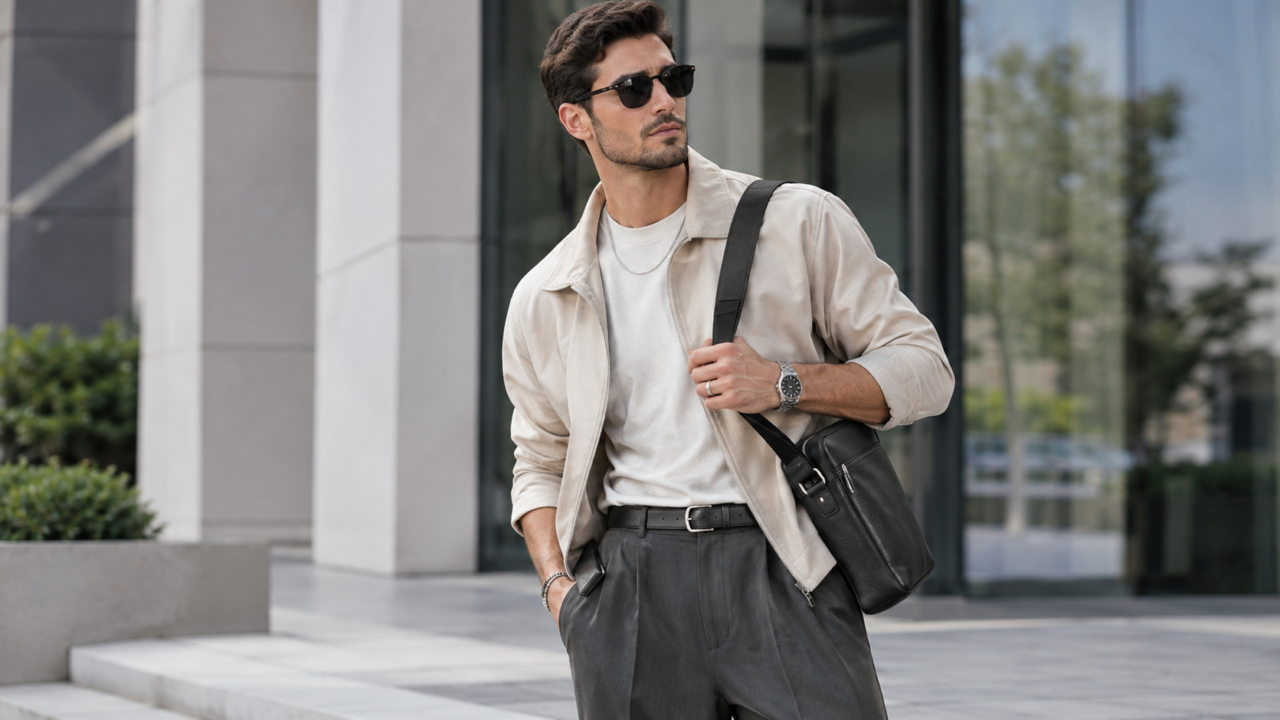
Men’s accessories can completely change the character of an outfit without requiring a new wardrobe. A watch can make a simple shirt and trousers feel considered; a leather belt can connect shoes and tailoring; sunglasses can alter the visual balance of the face; and a carefully chosen ring or bracelet can introduce personality without changing the clothes at all.
The important point is that accessories are not simply decorative extras. Some perform a practical job, some establish proportion or color balance, and others communicate personal taste. Historically, men’s dress has relied heavily on these details. Colonial Williamsburg’s historical clothing collection, for example, documents how hats, shoe buckles and other accessories were important parts of men’s dress rather than incidental additions.
Today, the category is considerably broader. Watches, wallets, belts, sunglasses and bags remain everyday staples, while jewelry, scarves, ties, caps, brooches and other statement pieces have become increasingly visible in contemporary menswear. Recent menswear coverage has particularly highlighted larger bags, ties, scarves, rosettes, bag charms and other expressive accessories.
The challenge is not finding accessories. There are thousands to choose from. The challenge is knowing which pieces actually belong in your wardrobe and how to make them work together.
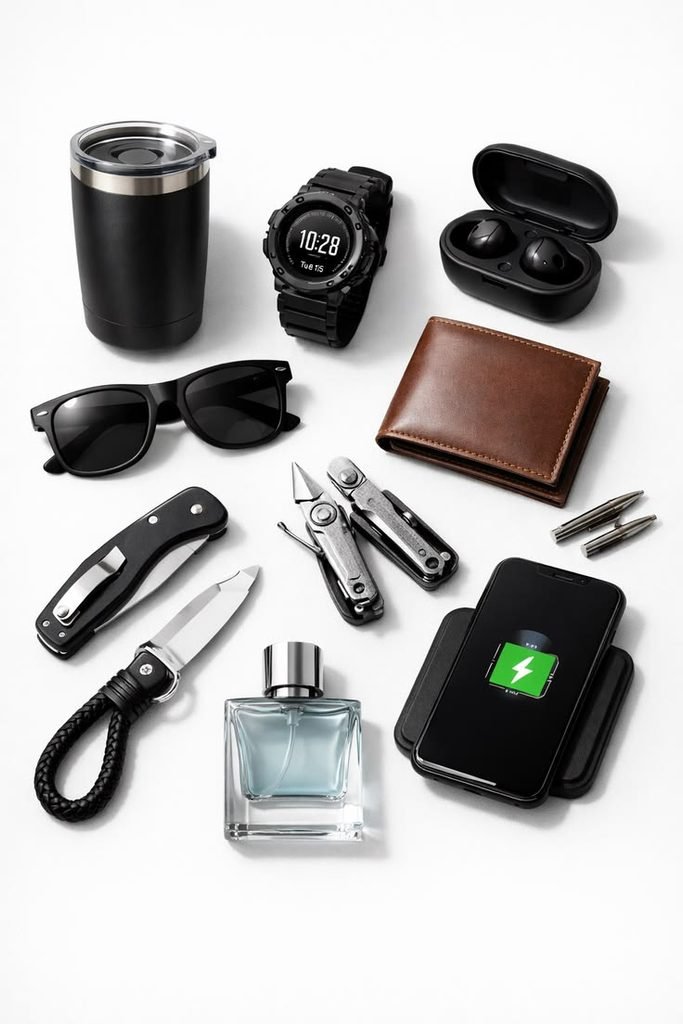
What Counts as Men’s Accessories?
A men’s accessory is generally an item worn or carried alongside clothing that adds function, visual interest, or both.
The category includes familiar pieces such as:
- Watches
- Belts
- Wallets and cardholders
- Sunglasses
- Bags
- Hats and caps
- Jewelry
- Ties
- Pocket squares
- Cufflinks
- Tie bars
- Scarves
- Gloves
- Socks
- Key holders and small leather goods
Retailers commonly divide men’s accessories into categories such as belts, wallets, bags, hats, ties, eyewear, cufflinks, scarves, gloves and watches, illustrating how broad the modern category has become.
But not every accessory has the same role.
A belt is closely connected to fit and proportion. A wallet is primarily functional but still visible when carried or used. A watch occupies a prominent position on the wrist. A necklace or ring is more directly expressive.
Thinking about accessories by function and visual impact is more useful than simply counting how many pieces you own.
Essential Men’s Accessories Every Wardrobe Can Use
There is no universal list that every man needs. Someone who wears tailoring every day has different requirements from someone whose wardrobe consists mostly of denim, knitwear and sneakers.
Still, certain categories are unusually versatile.
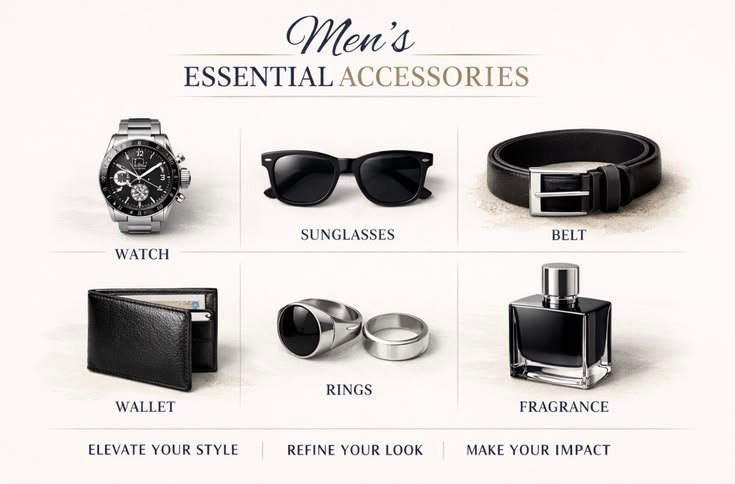
1. A Versatile Watch
A watch remains one of the most practical ways to introduce an accessory into an outfit.
For a first everyday watch, versatility is usually more useful than an unusual design. A clean dial, moderate case size and interchangeable strap options can allow the same watch to move between casual and smarter clothing.
Consider the relationship between the watch and your clothing.
A stainless-steel bracelet works naturally with denim, knitwear, tailoring and minimalist outfits. Leather straps can introduce a softer or more traditional character, while sportier watches suit casual wardrobes.
The watch should also make sense on your wrist. An oversized case can dominate a slim wrist, while a very small dress watch may disappear beneath a substantial jacket or knit.
The goal isn’t to find the most expensive watch. It is to find one whose scale, material and character make sense with the clothes you actually wear.
2. Leather or Fabric Belt
A belt is one of the few accessories that performs an obvious structural function.
Its position at the waist means it creates a horizontal visual line across the body, so its width, color and buckle can affect the appearance of an entire outfit.
For formal or business dressing, a relatively simple leather belt usually works best. Traditionally, matching the belt and shoe leather is a straightforward way to create visual continuity.
Casual dressing allows considerably more freedom. Woven belts, canvas belts, suede and textured leather can introduce material contrast without looking overly formal.
Avoid treating a belt as an afterthought. A belt that is dramatically more casual or more formal than the rest of an outfit can make the clothing feel disconnected.
3. Sunglasses
Sunglasses combine function with strong visual influence.
Because they sit directly on the face, their frame shape can alter the perceived proportions of the forehead, cheeks and jaw. That makes them one of the most noticeable accessories a man can own.
Start with quality lenses and appropriate UV protection before thinking about trends. Then consider frame shape, width, bridge position and color.
A simple black or tortoiseshell frame is relatively versatile. Colored lenses or unusual frame shapes can become a more deliberate statement.
The best sunglasses aren’t necessarily the most fashionable pair on social media. They are the pair whose proportions work with your face and whose character complements your wardrobe.
4. Wallet or Cardholder
A wallet is a perfect example of an accessory where function should influence design.
If you carry many cards, cash and receipts, an extremely slim cardholder may be frustrating. If you primarily use digital payments and carry a few cards, a compact cardholder may be more practical.
Leather remains popular because it develops surface character through use, but textile, metal and alternative materials can also work depending on the design.
The most important rule is simple: don’t let your wallet become bulky enough to distort the shape of your trousers.
A large wallet stuffed into a back pocket can create an obvious bulge and affect how trousers sit.
5. A Practical Everyday Bag
The modern man’s bag can be anything from a structured briefcase to a backpack, tote, crossbody or compact shoulder bag.
The right choice depends on what you carry.
For work, consider a bag that accommodates your laptop, documents and daily essentials without excessive bulk.
For weekends, a smaller crossbody or shoulder bag may be more appropriate.
Contemporary menswear has also expanded the role of larger bags. Vogue’s coverage of AW25 menswear identified oversized totes, weekenders and multifunctional bags among the notable accessories appearing across major runway collections.
This is an important shift because the bag is no longer merely something to hide behind the body. It can be a major part of an outfit’s silhouette.
6. Simple Jewelry
Men’s jewelry has moved well beyond the traditional wedding ring.
Rings, bracelets, chains, necklaces, pendants, earrings and brooches can all play a role in contemporary styling.
For someone new to jewelry, restraint usually makes the transition easier.
Start with one piece:
- A simple ring
- A slim bracelet
- A modest chain
- A signet-style ring
The material should suit your wardrobe. Sterling silver can work particularly well with cool neutrals, denim and monochrome clothing. Gold tones create more warmth and can complement earthy colors, cream, brown and olive.
You don’t need several pieces to make jewelry noticeable. A single well-proportioned ring can have more impact than a crowded combination of chains and bracelets.
7. Tie
The tie remains relevant wherever formal and professional dressing require it.
Its shape creates a strong vertical line through the center of the body, making proportion especially important.
A very wide tie can feel visually heavy with a narrow lapel. Conversely, an extremely narrow tie can look disconnected from a broad, traditional suit.
Color and pattern should also respond to the shirt and jacket rather than compete with them.
A plain shirt gives you more freedom with pattern. A patterned shirt usually benefits from a calmer tie.
8. Pocket Square
A pocket square is small but visually strategic.
It occupies the chest area, close to the jacket lapel, so it can connect the shirt, tie and jacket without matching them exactly.
The old habit of wearing an identical tie-and-pocket-square set can make an outfit appear overly coordinated.
Instead, look for a relationship through color, texture or pattern.
For example, a navy tie might work with a cream pocket square containing a subtle navy border. The colors communicate with one another without creating a perfectly duplicated pattern.
9. Cufflinks and Tie Bars
These accessories belong primarily to dressier wardrobes.
Cufflinks are designed for shirts with appropriate cuffs, while tie bars secure a tie to the shirt and introduce a small metallic detail.
Because both are relatively small, they work best when their scale is controlled.
A large decorative tie bar can quickly dominate a formal outfit. A simple metal design usually integrates more naturally.
10. Hats and Caps
Headwear can change the character of an outfit more dramatically than many accessories because it occupies the highest visible point of the silhouette.
Baseball caps work naturally with casual clothing, while wool caps, bucket hats, structured hats and other forms can communicate different style references.
The key is consistency.
A sporty cap with tailoring can work when the rest of the outfit intentionally bridges casual and formal elements. A random cap added to an otherwise highly formal outfit can look disconnected.
11. Scarf
A scarf combines texture, color and practical warmth.
Unlike a watch or belt, a scarf can introduce considerable volume around the neck. That makes it particularly useful with coats, overshirts and winter tailoring.
A lightweight scarf can also work during transitional seasons.
Pay attention to fabric weight. A bulky wool scarf paired with a lightweight summer shirt can create an obvious imbalance, while a fine cotton or linen scarf can sit more naturally with lighter clothing.
12. Quality Socks
Socks are often ignored because they are partly concealed, but they can become highly visible when trousers move while sitting, walking or crossing the legs.
There are two broad approaches.
You can make the socks blend with the trousers or shoes for a quieter appearance, or you can use them as a controlled color or pattern accent.
The important consideration is context.
Bright novelty socks may suit casual clothing but can look distracting with conservative business tailoring.
13. Gloves
Gloves have a clear practical role but can also contribute to the visual character of winter dressing.
Leather gloves tend to complement tailored coats and dressier outerwear. Knitted styles generally feel more relaxed.
As with belts and shoes, material quality becomes especially noticeable with gloves because they are regularly handled and exposed to weather.
14. Small Leather Goods
Key holders, passport holders, card cases, cable organizers and compact pouches are often overlooked because they are less visible.
Yet these objects can make a wardrobe feel more coherent.
A consistent material palette—such as black leather, brown leather or canvas—can create a subtle connection between the items you carry.
GQ’s coverage of men’s leather accessories has included wallets, key holders, passport holders and pouches, reflecting the long-standing relationship between practical utility and men’s accessory design.
15. Statement Accessories
Statement accessories are not essential, but they provide an opportunity for experimentation.
Examples include:
- Sculptural rings
- Oversized sunglasses
- Brooches
- Bold scarves
- Decorative bag charms
- Distinctive hats
- Colorful ties
- Unusual eyewear
Recent runway coverage shows designers using accessories as expressive elements rather than treating them only as functional objects. Vogue highlighted playful details including carabiners, bag charms, novelty jewelry and rosettes in recent menswear.
The trick is to give a statement piece enough space to be noticed.
If the sunglasses, necklace, bracelet, bag, shoes and jacket are all competing for attention, none of them becomes a convincing focal point.
How to Choose Accessories by Outfit and Occasion
The same accessory can look completely different depending on what surrounds it.
Casual and Weekend Dressing
Casual clothing gives you the greatest freedom.
A simple combination such as:
T-shirt + straight-leg jeans + sneakers + watch + sunglasses
already contains enough visual structure for an everyday outfit.
You could add a cap or crossbody bag without making the outfit complicated.
For streetwear, larger bags, statement eyewear, layered jewelry and distinctive headwear can work particularly well because the clothing itself often has stronger silhouettes.
The principle is balance.
If your clothing is oversized, accessories with some visual weight can prevent the look from feeling top-heavy or unfinished.
If your clothes are minimal and fitted, smaller accessories often create a cleaner result.
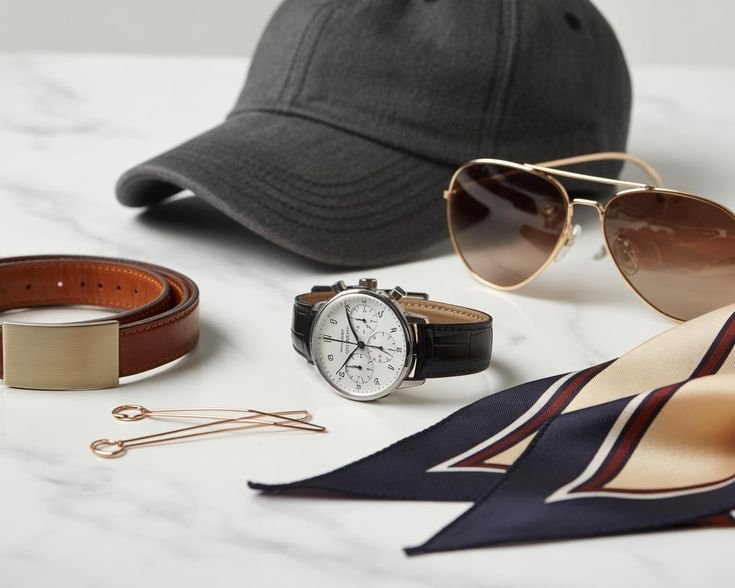
Work and Business Casual
Workwear generally benefits from accessories that are practical and restrained.
Consider:
- A structured bag
- A simple watch
- Leather belt
- Sunglasses for commuting
- Minimal jewelry
- Refined wallet
If your workplace has a conservative dress code, keep statement accessories for outside work.
A navy blazer, Oxford shirt and tailored trousers already communicate structure. Adding a simple watch and belt can complete the look without competing with it.
Formal Events
Formal dressing requires more discipline.
For a suit, the accessory choices might include:
- Watch
- Belt or formal shoes
- Tie
- Pocket square
- Cufflinks
- Tie bar
But you don’t necessarily need all of them.
The most successful formal outfits often depend on subtle relationships rather than the maximum number of details.
A textured pocket square, polished watch and restrained cufflinks can provide enough visual interest.
How to Coordinate Men’s Accessories
Accessory coordination doesn’t mean everything must match.
In fact, perfect matching can make an outfit feel overly deliberate.
Instead, think in terms of relationships.
Color and Material
Leather is a useful place to begin.
A dark brown leather belt can connect naturally with brown shoes and a brown leather watch strap. Black leather offers a sharper, more formal visual language.
Metal accessories work similarly.
If your watch is silver-toned, silver jewelry creates an obvious relationship. Gold jewelry can also work, but mixing several unrelated metal finishes can make an outfit feel visually fragmented.
That doesn’t mean silver and gold can never be worn together.
Mixed metals can look intentional when one tone dominates and the other appears as a secondary accent.
Proportion and Visual Weight
Proportion is one of the most overlooked principles in men’s accessories.
Imagine a man wearing:
- Oversized sunglasses
- A very large watch
- Thick chain
- Heavy bracelet
- Large rings
- Bulky bag
Each item might look excellent individually. Together, however, the total visual weight could overwhelm the outfit.
Now reverse the situation: slim trousers, delicate shoes, tiny watch and an extremely small bag.
The accessories may feel visually insignificant.
The objective is not mathematical symmetry. It is visual balance.
A substantial outfit can accommodate stronger accessories. A minimalist outfit often benefits from one carefully chosen focal piece.
Current Men’s Accessory Trends
The most interesting development in contemporary men’s accessories is not one specific item. It is the expanding definition of what counts as acceptable menswear styling.
Recent runway coverage has shown several directions.
Larger Functional Bags
Oversized totes, weekend bags and multifunctional designs have become prominent in recent menswear coverage. Vogue identified XXL bags as a notable AW25 accessory direction across Milan and Paris collections.
This reflects a practical reality: men increasingly carry laptops, chargers, cameras, water bottles and other daily equipment.
A large bag therefore doesn’t have to be purely theatrical. Its proportions can be functional.
Neckwear Beyond Traditional Office Dressing
Ties and scarves have also received renewed attention.
Instead of being restricted to conventional business clothing, neckwear can be incorporated into relaxed tailoring, knitwear and layered outfits. Recent runway coverage described ties and scarves being used creatively with both tailored and rugged looks.
More Expressive Jewelry
Rings, bracelets and necklaces are now a normal part of many contemporary men’s wardrobes.
The important distinction is between wearing jewelry because it suits your personal aesthetic and simply adding jewelry because it is currently popular.
A silver signet ring that works with your wardrobe is likely to serve you longer than a novelty piece chosen solely because it is trending.
Utility-Inspired Details
Carabiners, pouches, phone carriers and compact bags continue to blur the boundary between accessories and equipment.
This is particularly relevant to casual and streetwear.
The most interesting designs often combine utility with strong material and proportion choices.
Common Men’s Accessory Mistakes
Wearing Too Many Statement Pieces
A statement accessory needs visual space.
If everything is designed to attract attention, the outfit lacks hierarchy.
Choose one main accessory and allow the remaining pieces to support it.
Ignoring Scale
A very large watch can overwhelm a narrow wrist. Oversized sunglasses can dominate a small face. A tiny bag can look disproportionate with oversized outerwear.
Scale should be considered alongside body proportions and clothing silhouette.
Treating Matching as a Rule
Belts and shoes often benefit from coordination, particularly in formal dressing.
But not every accessory needs to match.
Your watch, bag, jewelry, glasses and shoes can share relationships through color temperature, texture or form without being identical.
Choosing Accessories Before Considering the Outfit
Accessories should support the clothes.
If you buy an unusual hat first and then try to construct your entire wardrobe around it, your choices become unnecessarily restrictive.
Start with the wardrobe foundation.
Then identify which accessory categories are missing.
Buying for Novelty
A drawer full of accessories does not necessarily create better style.
A better collection might contain:
- One versatile watch
- Two useful belts
- One quality wallet
- One pair of sunglasses
- One everyday bag
- One or two jewelry pieces
- Appropriate formal accessories
The objective is versatility rather than quantity.
How to Build an Accessories Collection Without Overbuying
If you’re starting from scratch, don’t buy everything simultaneously.
Begin with accessories that solve everyday problems.
First: Choose a versatile watch.
Second: Add a quality belt appropriate to your most common shoes.
Third: Buy sunglasses that fit your face and lifestyle.
Fourth: Choose a wallet or cardholder based on what you actually carry.
Fifth: Add an everyday bag if your clothing lacks a practical carrying option.
Sixth: Experiment with one piece of jewelry.
Finally: Add occasion-specific pieces such as ties, pocket squares, cufflinks or scarves.
This order is useful because each purchase fills a genuine gap rather than simply increasing the size of your accessory collection.
You can also build two accessory wardrobes: an everyday system and an occasion system.
Your everyday system might contain a watch, sunglasses, belt, wallet and bag.
Your formal system might add cufflinks, tie, pocket square and dressier watch.
This approach keeps your choices manageable.
The Role of Accessories in Personal Style
Accessories become most interesting when they stop being generic additions and begin reflecting the person wearing them.
Consider two men wearing the same white shirt and navy trousers.
One wears a steel watch, leather belt and minimalist leather bag.
The other wears a vintage-style watch, silver ring, textured belt and canvas crossbody.
The clothing is nearly identical, but the visual language is different.
That is the real strength of accessories.
They allow people to alter the character of familiar clothing without constantly buying new garments.
This is particularly valuable for a capsule wardrobe. A small clothing collection can produce more visual variation when accessories are used intelligently.
Accessories can also connect different parts of a wardrobe.
A brown leather watch strap might repeat the tone of boots. A burgundy scarf might echo a subtle color in a shirt. A silver ring might relate to a metal watch bracelet.
These connections are subtle, but they help outfits feel considered.
Materials Matter More Than Logos
A common mistake in accessory shopping is focusing too heavily on branding.
For many accessories, material and construction have a much greater effect on appearance and longevity.
With leather, examine the grain, stitching, edge finishing and hardware.
With metal jewelry, consider the material, finish and weight.
With bags, inspect seams, zippers, handles, lining and strap construction.
With sunglasses, pay attention to frame quality, lens protection and fit.
The best accessory for your wardrobe isn’t automatically the one with the most recognizable logo.
Good design can communicate quality through proportion, material and construction.
Accessories and Sustainability
Accessories can also play a role in a more considered wardrobe.
Because accessories are smaller than garments, they can sometimes be easier to repair, maintain or replace selectively rather than replacing an entire outfit.
A well-maintained leather belt can remain useful for years. A quality watch can be serviced. Metal jewelry can often be polished or repaired. A durable bag may replace several cheaper bags over time.
That does not mean every expensive accessory is automatically sustainable.
These questions shift purchasing away from impulse and toward longevity.
Final Thoughts
Men’s accessories work best when they have a clear relationship with the rest of the outfit.
A watch can provide structure. A belt can connect footwear and trousers. Sunglasses can frame the face. A bag can introduce a new proportion. Jewelry can communicate personality. A scarf can add texture. Even something as small as a pocket square can change the balance of formal clothing.
The goal is not to collect as many accessories as possible.
It is to understand what each piece contributes.
Build around the accessories you will genuinely use, pay attention to proportion and material, and allow your personal style to develop gradually. The strongest accessory collection is rarely the largest one. It is the one in which every piece has a reason to be there.
FAQ
What are the most essential men’s accessories?
A versatile watch, quality belt, sunglasses, wallet or cardholder, practical bag and one piece of jewelry form a useful starting point. Formal wardrobes may also require ties, pocket squares and cufflinks.
How many accessories should a man wear at once?
There is no fixed maximum. For everyday outfits, two or three visible accessories are often enough to create interest without making the look visually crowded. More can work when the styling is intentional.
Should men’s accessories match?
They don’t need to match exactly. Accessories generally look more cohesive when they share some relationship in color, material, finish or visual weight.
What jewelry should a man wear first?
A simple ring, signet-style ring, slim bracelet or understated chain can be a good starting point. Choose one piece that fits naturally with your existing wardrobe.
How should a man match his belt and shoes?
For formal and business dressing, coordinating the belt and shoe color and leather character is a reliable approach. Casual outfits allow more flexibility with woven, canvas, suede and contrasting belts.
Are men’s accessories still fashionable in 2026?
Yes. Current menswear coverage continues to feature accessories prominently, including oversized bags, ties, scarves, jewelry, bag charms and other expressive details.
What accessories work best with casual clothes?
Watches, sunglasses, caps, crossbody bags, casual belts, bracelets and simple rings can work well with casual wardrobes. The exact combination should reflect the silhouette and visual weight of the clothing.
How can men avoid looking overdressed with accessories?
Start with one focal accessory and let the others remain relatively quiet. Pay particular attention to proportion, color and formality. If the accessories attract more attention than the clothing, simplify the combination