Learning how to choose sustainable clothing brands is more complicated than looking for a green leaf on a website or buying something described as “eco-friendly.”
A genuinely responsible clothing brand should be able to explain more than the fibre used in a garment. You also need to consider how that fibre was produced, where the garment was made, how workers are treated, whether the supply chain is transparent, how long the clothing is likely to last, and what happens when the garment reaches the end of its useful life.
That matters because the environmental impact of fashion begins well before a garment reaches a shop. It can involve raw-material production, spinning, weaving or knitting, dyeing, finishing, manufacturing, transportation, consumer use and disposal. UNEP describes the textile sector as an important contributor to climate, pollution, biodiversity and waste challenges and is pushing the industry toward more circular production and consumption.
The good news is that shoppers do not need to become textile scientists to make better decisions.
You can develop a simple system: check the material, investigate the evidence, examine the people behind the garment, assess quality, and question broad sustainability claims.
What Makes a Clothing Brand Sustainable?
There is no single feature that automatically turns a fashion brand into a sustainable brand.
Organic cotton alone does not tell you whether workers were fairly treated. Recycled polyester does not tell you how frequently a company produces new collections. A “conscious” collection does not necessarily describe the environmental performance of the entire business.
Sustainability is better understood as a combination of environmental and social practices.
Look for evidence across several areas:
- Materials: What fibres are being used and why?
- Production: Where are garments manufactured?
- Chemicals: Does the company address dyeing and chemical management?
- Workers: What does the brand say about wages, safety and working conditions?
- Transparency: Can you identify suppliers or production regions?
- Durability: Are garments designed to be worn repeatedly?
- Circularity: Does the brand offer repair, resale, take-back or recycling options?
- Business model: Is the company constantly encouraging excessive consumption?
- Claims: Are environmental statements specific and supported by evidence?
This broader approach is important because sustainability problems can occur at different points in the same garment’s lifecycle.
UNEP’s textile roadmap emphasizes three connected areas: changing consumption patterns, improving industry practices and investing in infrastructure.
In other words, sustainable fashion is not simply about buying a particular type of fabric.
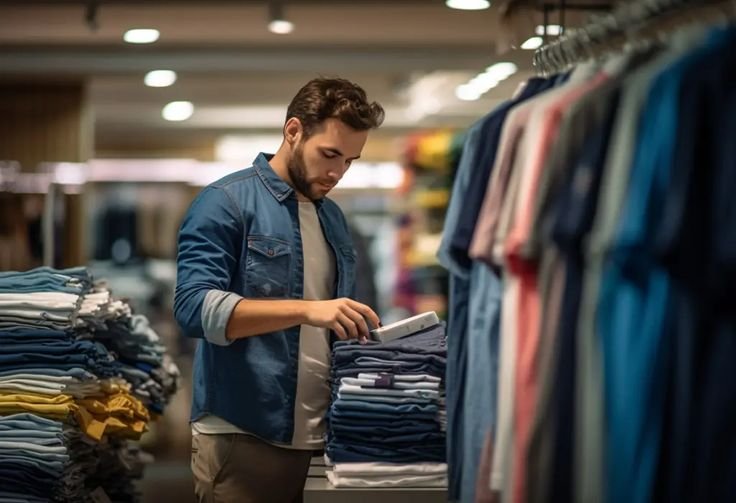
How to Choose Sustainable Clothing Brands
The following checks can help you evaluate almost any clothing company, from a small independent label to a large international retailer.
Look Beyond the Fabric Label
Fabric is an excellent place to start, but it should not be the end of your investigation.
Suppose two shirts are made from organic cotton. One may come from a brand that provides detailed information about farms, factories, certifications, worker protections and production quantities. The other may provide almost no information beyond the words “organic cotton.”
The fibre tells you something important, but not everything.
When evaluating a garment, ask:
What is the fibre?
Check the composition label rather than relying on product photography or marketing language.
What percentage is that fibre?
A garment described as “recycled” may contain only a small proportion of recycled material.
Is the claim verified?
A recognized certification or independently verifiable standard can be more useful than a brand’s own sustainability badge.
Why was this material chosen?
A good sustainability page should explain the company’s material strategy rather than simply presenting a long list of fashionable eco terms.
The Federal Trade Commission’s guidance on environmental marketing also warns against broad, unqualified claims such as “green” or “eco-friendly.” Environmental claims should be specific and substantiated.
That is a useful principle for shoppers everywhere: the more impressive the environmental claim sounds, the more specific the supporting evidence should be.
Check Certifications and Standards
Certifications cannot answer every sustainability question, but they can provide useful evidence.
Different standards cover different parts of the textile system, so don’t treat every certification as interchangeable.
For example, OEKO-TEX STANDARD 100 focuses on testing textiles for harmful substances. It does not mean that every product carrying the label is automatically environmentally perfect. The standard is primarily about textile safety and harmful-substance testing.
Fairtrade addresses social, economic and environmental criteria within certified supply chains. Its cotton programs are designed to support farmers, while its textile standards address areas including worker rights and working conditions.
bluesign takes a different approach, examining chemical inputs and production processes and assessing areas such as resource use, environmental performance and worker safety.
GOTS, or the Global Organic Textile Standard, is another important name to understand when researching organic textiles. The Global Standard publishes the GOTS standard and implementation resources and continues to update its textile sustainability framework.
The key lesson is simple:
A certification should tell you what is actually being certified.
Do not assume one certification covers the entire fashion brand.
A garment can be certified for one particular attribute while the company has weaknesses elsewhere.
Investigate Supply-Chain Transparency
One of the strongest signals of a serious sustainability strategy is the amount of useful information a company is willing to disclose.
Look for information about:
- Manufacturing countries
- Factory locations
- Material suppliers
- Spinning and weaving facilities
- Dyeing and finishing facilities
- Auditing practices
- Worker standards
- Environmental targets
- Progress reports
- Supplier relationships
A brand does not need to reveal every commercial secret to demonstrate transparency.
But there is a meaningful difference between saying:
“We care about people and the planet.”
and providing detailed information about where products are made and what standards apply to those facilities.
Supply-chain transparency is particularly important because the final brand label does not reveal the complex network behind a garment.
A T-shirt might involve cotton farming, ginning, spinning, knitting, dyeing, cutting, sewing, finishing, packaging and distribution across several countries.
The more clearly a brand explains that chain, the easier it becomes for consumers to evaluate its claims.
Examine Labor and Worker Policies
Sustainability is not only an environmental question.
A garment cannot reasonably be described as responsible simply because it uses an environmentally preferable material if the people producing it work under unsafe or unfair conditions.
Look for policies covering:
- Worker health and safety
- Freedom of association
- Forced labor
- Child labor
- Working hours
- Wages
- Grievance mechanisms
- Supplier standards
- Independent auditing
- Corrective action
Pay particular attention to whether the company explains what happens when problems are found.
A policy document is easy to publish.
A credible system should also explain how suppliers are monitored and how violations are addressed.
Fairtrade’s textile framework, for example, specifically addresses areas such as working conditions and wages, showing why social sustainability deserves separate attention from material choice.
Understand Which Sustainable Fabrics Actually Matter
Materials are one of the most confusing parts of sustainable fashion because there is no universally perfect fibre.
Every material has trade-offs.
Organic and Recycled Fibres
Organic fibres can be useful when their production is properly verified. Recycled fibres can reduce the need for virgin raw materials in certain applications.
But the word “recycled” should trigger another question:
Recycled from what, and how much?
Check whether the product page provides a percentage and identifies the source of the recycled material.
Likewise, “organic cotton” is more meaningful when supported by an established certification rather than simply appearing in marketing copy.
OEKO-TEX, for example, distinguishes its STANDARD 100 safety certification from its other labels and standards, illustrating why consumers should learn what each label actually verifies.
Natural Does Not Always Mean Sustainable
Natural fibres are often presented as automatically better than synthetic fibres.
That is too simplistic.
Natural fibres still require land, water, agricultural inputs, processing and transportation. Synthetic fibres have different environmental concerns, including their fossil-based origins in many cases and the release of microfibres during use and washing.
The better question is not:
“Is this fabric natural?”
Ask:
“What are the environmental and social trade-offs of this material in this particular product?”
A durable garment that remains in someone’s wardrobe for years may have a very different overall impact from a poorly made garment that is discarded quickly, regardless of the fibre.
UNEP specifically highlights longer use, reuse, repair and circular approaches as important parts of reducing fashion waste.
Look at Garment Quality and Longevity
This is one of the most overlooked parts of sustainable shopping.
A garment that lasts is potentially a better purchase than one marketed with impressive environmental terminology but constructed poorly.
Before buying, inspect:
- Stitching
- Seam finishing
- Fabric density
- Buttons and fasteners
- Zippers
- Hem construction
- Lining
- Pocket construction
- Print quality
- Stretch recovery
- Fabric feel
- Fit and pattern balance
Think like a fashion designer for a moment.
Good design is not simply an attractive silhouette. It is also about proportion, construction, function and durability.
A beautifully designed jacket with reinforced seams and replaceable buttons may remain useful for years.
A cheap trend piece with weak stitching may look appealing online but lose its shape after a few washes.
This is why the most sustainable purchase is often the garment you actually enjoy wearing repeatedly.
How to Spot Greenwashing in Fashion
Greenwashing occurs when sustainability-related marketing creates a more environmentally responsible impression than the available evidence supports.
The problem is not always an outright false statement. Sometimes the issue is that a small positive feature is presented as if it represents the entire business.
Be cautious when you see phrases such as:
- “Eco-friendly”
- “Planet positive”
- “Conscious”
- “Clean fashion”
- “Green”
- “Earth-loving”
- “Sustainable collection”
These phrases are not automatically false.
The question is:
What exactly do they mean?
The FTC’s Green Guides explain that broad environmental claims can be difficult to substantiate and should not create a misleading overall impression.
A Better Way to Read Sustainability Claims
Imagine a product page says:
“Made with sustainable materials.”
That sounds positive, but it does not answer several important questions.
Which materials?
What percentage?
Certified by whom?
What about the remaining materials?
Where was it manufactured?
What environmental improvements were made during production?
What happens to the garment after use?
Now compare that with a brand that identifies the fibre composition, certification, manufacturing location, supplier information and specific environmental objectives.
The second approach gives you something you can evaluate.
The Federal Trade Commission has even taken action over misleading textile claims involving products marketed as bamboo when the actual textile was rayon made from bamboo through chemical processing.
That example demonstrates why material terminology matters.
Sustainability Beyond the Garment
A sustainable clothing brand should ideally consider what happens before and after the garment is sold.
Packaging
Excessive packaging can undermine an otherwise thoughtful product strategy.
Check whether packaging is:
- Necessary
- Reusable
- Recyclable
- Minimally designed
- Clearly labeled for disposal
Don’t make packaging your main sustainability criterion, though. The environmental impact of the garment itself can be far more significant than a cardboard mailer.
Repair
Repair is a strong signal of longevity.
Look for brands offering:
- Replacement buttons
- Repairs
- Alteration support
- Spare parts
- Repair guides
- Repair services
- Warranty programs
A brand that encourages customers to keep clothing longer is approaching fashion differently from a company whose entire strategy depends on constant replacement.
Resale and Take-Back Programs
Some brands offer resale platforms or take-back schemes.
These can be useful, but investigate what the program actually does.
“Take back your old clothes” does not automatically mean every garment is recycled into new clothing.
Look for explanations of how returned items are sorted and what happens afterward.
A Simple Sustainable Brand Checklist
Before purchasing from a new clothing brand, ask these questions:
| Question | What to Look For |
|---|---|
| What is the garment made from? | Clear fibre composition |
| Is the material claim verified? | Recognized certification or evidence |
| Where is it made? | Country and, ideally, supplier information |
| Who makes it? | Factory and supply-chain transparency |
| How are workers treated? | Clear labor policies and monitoring |
| Is the garment durable? | Construction, fabric and repairability |
| Does the brand overproduce? | Reasonable collections and production model |
| Does it offer repair or resale? | Practical circularity programs |
| Are environmental claims specific? | Evidence instead of vague slogans |
| Can I wear it often? | Versatility and personal relevance |
You don’t need a brand to score perfectly in every category.
Instead, use the checklist to identify strengths, weaknesses and unanswered questions.
Common Mistakes Shoppers Make
Mistake 1: Assuming Expensive Means Sustainable
Price and sustainability are not synonyms.
A high price may reflect design, branding, craftsmanship, retail costs or scarcity. It does not automatically prove responsible production.
Look for evidence rather than using price as a shortcut.
Mistake 2: Assuming Organic Means Ethical
Organic agriculture and worker welfare are related sustainability conversations, but they are not identical.
An organic fibre certification may tell you something about agricultural or textile processing criteria without answering every question about wages or garment workers.
Always check the scope of the certification.
Mistake 3: Buying More “Sustainable” Clothes Than You Need
This is perhaps the biggest contradiction in conscious shopping.
Replacing a closet full of wearable clothing with a new wardrobe marketed as sustainable can still encourage unnecessary consumption.
UNEP emphasizes that reducing consumption and increasing the useful life of clothing are important parts of moving toward a more sustainable textile system.
Sometimes the most sustainable choice is simply not buying another garment.
Mistake 4: Focusing Only on Materials
Materials matter, but sustainability is bigger than fibre composition.
Two garments made from the same material can differ substantially in construction, durability, manufacturing practices and worker conditions.
Mistake 5: Treating Sustainability as Perfection
No clothing brand is likely to have zero environmental impact.
Textile production involves resources, transportation, energy, water, chemicals and human labor.
A better approach is to ask:
Is this company demonstrating measurable improvement, transparency and responsible decision-making?
That question is more useful than searching for a supposedly perfect brand.
Can Sustainable Fashion Be Affordable?
Yes, but sustainable shopping often requires changing the definition of “value.”
Instead of asking only:
“How cheap is this shirt?”
consider:
“How much use will I get from this shirt?”
A $25 garment worn twice has a different value proposition from a $70 garment worn 60 times.
You can also reduce costs by:
- Buying fewer pieces
- Shopping second-hand
- Choosing versatile garments
- Repairing damaged clothing
- Buying classic pieces during sales
- Avoiding impulse purchases
- Building a smaller wardrobe
- Choosing garments that work across several outfits
Second-hand clothing deserves particular attention because extending the useful life of an existing garment avoids the need for a new garment to be produced immediately.
It also changes the relationship between fashion and consumption.
Instead of treating clothing as disposable seasonal merchandise, you begin to view garments as products with a useful life that can be extended.
How Your Own Shopping Habits Affect Sustainability
Brand responsibility matters, but consumer behavior matters too.
A highly responsible brand cannot completely compensate for constant overconsumption.
Once you buy a garment, how you care for it affects its useful life.
Follow the care instructions. Wash only when necessary. Avoid unnecessarily harsh treatment. Repair small problems before they become major ones. Store garments appropriately.
Laundry also matters because washing textiles can release microfibres, particularly from synthetic fabrics. UNEP has highlighted microfiber pollution as part of the broader textile environmental challenge.
The goal isn’t to make clothing ownership complicated.
It is to keep garments in active use for as long as reasonably possible.
How Fashion Design Can Support Sustainability
Sustainability begins partly at the design stage.
A designer can influence:
- Material selection
- Pattern efficiency
- Garment construction
- Durability
- Repairability
- Versatility
- Disassembly
- Fit
- Product lifespan
Consider a simple white shirt.
A designer could create it as a disposable seasonal item, or design it around a reliable pattern, durable fabric, replaceable buttons, strong seams and a silhouette that remains wearable beyond one trend cycle.
That distinction is important.
Sustainable fashion isn’t necessarily visually minimal or plain. A dramatic dress, tailored blazer or statement accessory can still be a responsible purchase if it is well made, genuinely valued by its owner and used for a long time.
Sustainability and personal style do not have to compete.
The Best Sustainable Clothing Brand May Be Different for Every Shopper
There is no single brand that will be ideal for every person.
A consumer in New York may prioritize supply-chain transparency and recycled materials.
Someone shopping in Europe may care strongly about local manufacturing.
A budget-conscious student may prioritize second-hand shopping and garment durability.
A professional building a capsule wardrobe may prioritize tailoring, construction and long-term versatility.
Someone with sensitive skin may put greater importance on textile safety standards.
Your priorities influence what “better” means.
The important thing is to make the decision consciously instead of allowing a marketing slogan to make it for you.
A Five-Minute Research Method Before You Buy
You don’t need to spend an hour investigating every T-shirt.
Try this quick process.
Step one: Read the fibre composition.
Don’t rely only on the product title.
Step two: Look for certifications.
Check what the certification actually covers.
Step three: Visit the brand’s sustainability or responsibility page.
Look for concrete information rather than inspirational language.
Step four: Search for supply-chain information.
Can you find factories, manufacturing countries or supplier disclosures?
Step five: Assess the garment itself.
Is the fit good? Is the construction convincing? Will you wear it frequently?
If a brand performs reasonably well across those five areas, you’ve made a more informed decision than simply searching for the words “eco-friendly.”
Final Thoughts
Learning how to choose sustainable clothing brands is ultimately about becoming a more critical fashion consumer.
Don’t judge a brand from one fabric, one certification or one attractive sustainability campaign.
Look at the complete picture.
Check what the garment is made from. Understand what certifications mean. Investigate transparency. Consider workers as well as environmental impacts. Examine construction and durability. Question vague green claims. Look for repair, resale and circularity initiatives. Most importantly, think about whether you genuinely need the garment and how often you are likely to wear it.
The most useful shift is from “Which brand is sustainable?” to “What evidence shows that this brand is making responsible choices?”
That question gives you a practical way to shop across different price points, countries and fashion categories without relying entirely on marketing.
Sustainable fashion is not about achieving a perfectly guilt-free wardrobe. It is about making better decisions with the information available—and expecting fashion companies to provide better information in the first place.

FAQ
What makes a clothing brand sustainable?
A sustainable clothing brand considers multiple factors, including materials, manufacturing, worker welfare, chemical management, supply-chain transparency, durability, waste and end-of-life options. No single material or certification automatically makes an entire brand sustainable.
How can I tell if a clothing brand is ethical?
Look for information about factories, working conditions, wages, worker safety, supplier standards, auditing and grievance systems. Stronger brands generally provide specific information rather than relying only on broad ethical-fashion statements.
Is organic cotton always sustainable?
No. Organic cotton can offer environmental advantages depending on how it is grown and processed, but the term does not automatically answer questions about garment manufacturing, worker conditions, durability or transportation. Certification can help verify specific claims.
What certifications should I look for in sustainable clothing?
Useful certifications depend on what you want to verify. GOTS can be relevant to organic textile claims, OEKO-TEX STANDARD 100 focuses on harmful-substance testing, Fairtrade addresses social and trading standards within relevant supply chains, and bluesign focuses heavily on responsible textile production and chemical management.
How do I avoid greenwashing when shopping for clothes?
Be skeptical of vague claims such as “green” or “eco-friendly” when they are not supported by specific information. Look for measurable details about materials, percentages, certifications, manufacturing and environmental improvements. The FTC specifically advises marketers to substantiate environmental claims.
Are expensive clothing brands more sustainable?
Not necessarily. Price does not prove ethical or environmental performance. Evaluate the brand’s materials, supply chain, labor policies, construction quality, transparency and sustainability evidence instead.
Is buying fewer clothes better than buying sustainable clothes?
Often, buying fewer and using clothing for longer can be an important part of reducing fashion’s environmental impact. UNEP’s textile work emphasizes changing consumption patterns alongside improved production and infrastructure.
What is the most important thing to check before buying sustainable clothing?
Start with the garment itself: Will you wear it regularly and keep it for a long time? Then investigate its material, certification, manufacturing and brand transparency. Durability and actual use are important parts of a more responsible wardrobe.
Conclusion
Choosing sustainable clothing brands is less about finding a perfect company and more about learning how to recognize meaningful evidence. Before buying, look beyond labels such as “eco-friendly” or “conscious” and examine the garment’s materials, certifications, manufacturing process, worker policies, durability, and the brand’s overall transparency.
A sustainable wardrobe also depends on how you shop. Buying fewer pieces, choosing well-made clothing, repairing garments, wearing them for longer, and considering second-hand options can make a meaningful difference. The most responsible purchase is often not the garment with the most impressive marketing claim, but the one you genuinely need, will wear frequently, and can keep in your wardrobe for years.
As fashion continues to address its environmental and social challenges, consumers have an important role to play. By asking better questions and expecting clear evidence from brands, you can make more informed choices while still enjoying personal style, creativity, and quality clothing.