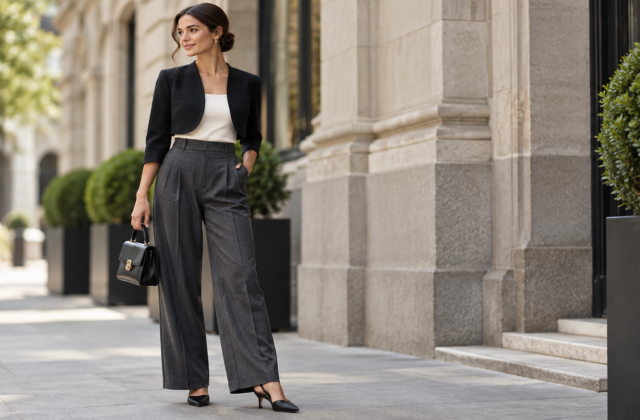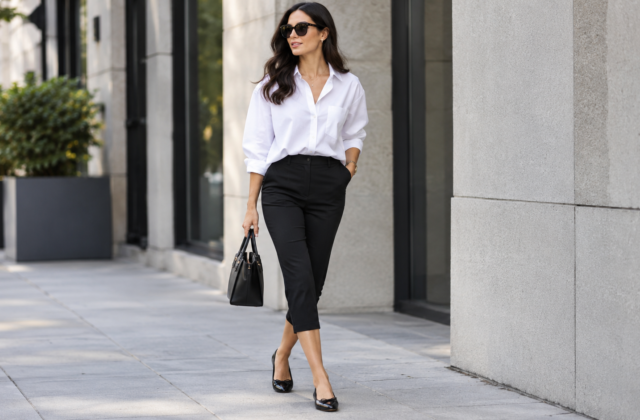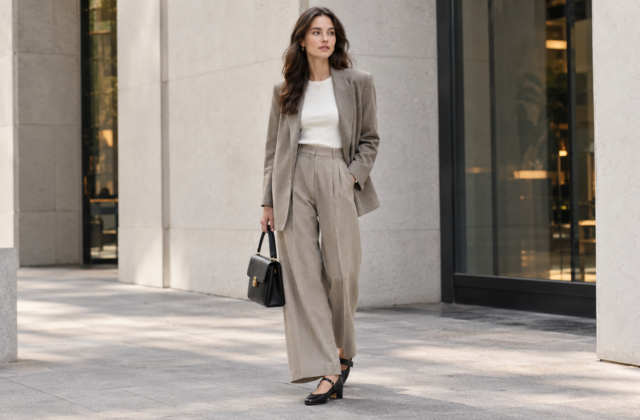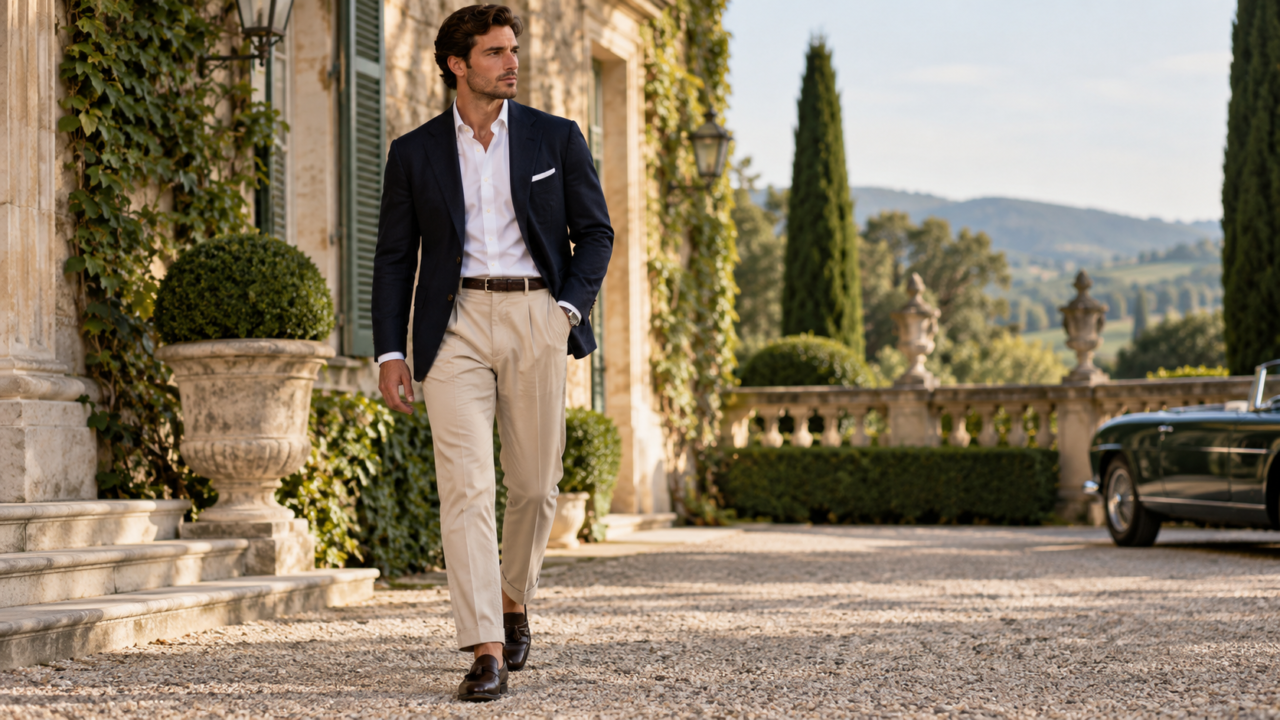
Old money style is less about looking rich and more about looking established, polished, and comfortable in classic clothing. The modern aesthetic usually combines tailored basics, restrained colors, traditional fabrics, understated accessories, and silhouettes associated with Ivy League, preppy, country-club, British country, and resort dressing.
The phrase itself is relatively new as a social-media fashion label, but many of the clothes associated with it are not new at all. Oxford shirts, navy blazers, loafers, cable-knit sweaters, chinos, pleated trousers, knit polos, simple dresses, leather accessories, and fine knitwear have existed independently of the “old money” label for decades.
That distinction matters. If you approach the look as a costume built around appearing wealthy, it can quickly become artificial. If you approach it as a system of good proportions, durable fabrics, restrained color, and thoughtful styling, it becomes much more useful.
This guide explains the history behind old money style, the garments and materials that define it, how men and women can wear it, how it differs from quiet luxury and preppy fashion, and how to create the aesthetic without relying on expensive labels.
What Is Old Money Style?
Old money style is a fashion aesthetic associated with the visual codes of inherited wealth, traditional institutions, leisure, education, and established social environments.
In contemporary fashion culture, the term often describes outfits featuring:
- Navy or charcoal tailoring
- Oxford button-down shirts
- Polo shirts
- Cable-knit sweaters
- Fine-gauge knitwear
- Chinos and tailored trousers
- Loafers
- Leather belts
- Simple watches
- Structured coats
- Pleated or straight-leg trousers
- Neutral dresses and skirts
- Minimal jewelry
- Classic sunglasses
- Natural-looking fabrics and textures
The important point is that no single garment makes an outfit old money.
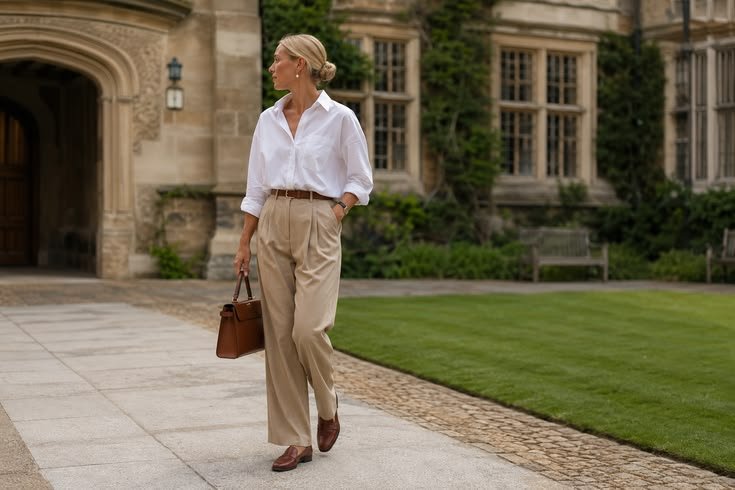
A navy blazer can look traditional, modern, corporate, streetwear-inspired, or even formal depending on its cut and styling. The same is true of loafers, knitwear, or a white shirt.
Old money style works through relationships between pieces.
A relaxed Oxford shirt with straight trousers and loafers creates a different impression from the same shirt tucked into skinny jeans with highly visible designer accessories.
The aesthetic therefore depends heavily on proportion, fabric, color, and restraint.
GQ has described the contemporary old-money aesthetic as drawing heavily from mid-century East Coast elite and Ivy League dress, while noting that many of its current followers reinterpret those references through social media.
This is also why the aesthetic can overlap with quiet luxury, although the two terms are not perfectly interchangeable.
Where Old Money Style Comes From
The current “old money” label simplifies a much larger fashion history.
Its visual vocabulary comes from several different traditions rather than one specific wardrobe.
Ivy, prep, and collegiate influences
One of the strongest influences is American collegiate and Ivy style.
Sportswear became increasingly important to American fashion during the twentieth century, particularly through clothing associated with university campuses and sporting activities. The Metropolitan Museum of Art notes that college campuses and playing fields played an important role in the development of modern American sportswear, with department stores eventually using “college shop” and “university shop” categories to market related menswear.
That history helps explain why old money style often includes:
- Rugby shirts
- Polo shirts
- Oxford shirts
- Letterman-inspired knitwear
- Chinos
- Loafers
- Cable-knit sweaters
- Navy blazers
- Cricket and tennis references
These pieces were not originally created simply to signal wealth. Many were practical clothing for sport, education, leisure, or everyday life.
That is one reason the aesthetic works best when the clothing appears lived-in rather than theatrically luxurious.
Country, resort, and leisure dressing
Another important influence comes from leisure clothing.
Think of traditional sailing, tennis, golf, equestrian activities, country weekends, Mediterranean holidays, and British countryside dressing.
This explains the presence of:
- Linen shirts
- Knit polos
- Cotton trousers
- Loafers
- Riding-inspired boots
- Lightweight jackets
- Cable knits
- Breton-inspired tops
- Structured outerwear
- Simple swimwear
- Straw accessories
The modern old money aesthetic often compresses all of these worlds into one visual language.
That can be misleading historically, because a person wearing a polo shirt and loafers today is not necessarily reproducing the wardrobe of any particular wealthy social group.
Instead, they are borrowing familiar fashion symbols associated with tradition and leisure.
The historical story is also more diverse than the social-media version suggests. The Met’s research on Black Ivy, for example, documents how Black men adopted and transformed Ivy League clothing, turning an originally exclusive visual language into something more expressive and culturally distinctive.
That is an important reminder: fashion references rarely stay inside the social group that first popularized them.
The Core Principles of Old Money Style
Old money style becomes much easier to understand when you stop thinking about individual “rich-looking” pieces and start thinking about design principles.
Restraint
The outfit should not compete with itself.
If the blazer has strong texture, the shirt can remain simple. If the trousers have a distinctive pleat or drape, accessories do not need to be dramatic.
The goal is visual balance.
Fit over branding
A modestly priced garment with good proportions can look more refined than an expensive garment with a poor fit.
Pay attention to:
- Shoulder width
- Sleeve length
- Trouser break
- Waist placement
- Rise
- Jacket length
- Collar shape
- Overall silhouette
For trousers in particular, the relationship between waist, thigh, leg opening, and shoe is critical.
A classic straight or softly relaxed trouser often supports the aesthetic better than an extremely narrow silhouette.
Quality of texture
The eye reads texture before it reads price.
Wool, linen, cotton, suede, leather, cashmere, merino, silk, and substantial knitwear can create visual depth even when an outfit uses only two or three colors.
This is why a cream knit sweater and navy trousers can look more sophisticated than a complicated outfit containing many colors and logos.
Repetition of classic shapes
Old money dressing relies on familiar silhouettes.
A navy blazer remains recognizable. A white button-down remains recognizable. A loafer remains recognizable.
The interest comes from how those pieces are combined, not from making every garment unusual.
Ease
One of the most important details is avoiding excessive stiffness.
A blazer does not need to look like corporate officewear. A shirt does not need to be aggressively pressed. Trousers should allow natural movement.
The look should suggest that the wearer is accustomed to the clothes.
That is very different from dressing as though you are deliberately trying to convince people that you belong to a particular social class.
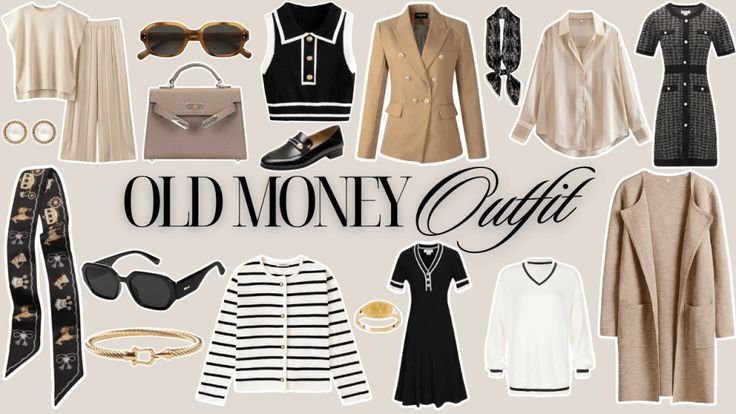
The Old Money Color Palette
Color is one of the easiest ways to establish the aesthetic.
The traditional palette is relatively restrained:
| Core color | Where it works |
|---|---|
| Navy | Blazers, trousers, knitwear |
| White | Shirts, dresses, knitwear |
| Ivory | Sweaters, trousers, blouses |
| Beige | Chinos, coats, knitwear |
| Camel | Coats, sweaters, accessories |
| Brown | Shoes, belts, leather |
| Charcoal | Trousers, suits, coats |
| Olive | Jackets, trousers, casual layers |
| Burgundy | Knitwear, ties, accessories |
| Pale blue | Shirts and lightweight knitwear |
This does not mean old money style must be colorless.
Traditional prep, for example, has historically included brighter colors and distinctive patterns. GQ’s discussion of the aesthetic specifically points out that the contemporary social-media version often simplifies the more colorful and eccentric reality of traditional prep.
A more interesting approach is to use one controlled accent.
For example:
Navy blazer + white shirt + khaki trousers + burgundy socks
is more visually sophisticated than simply making every item beige.
Likewise:
Cream knit + olive trousers + brown loafers
creates depth while remaining restrained.
Fabrics and Textures That Make the Look Work
Fabric selection can transform an ordinary outfit into something much more considered.
Wool
Wool is useful for:
- Blazers
- Trousers
- Coats
- Suits
- Lightweight knitwear
A wool blazer with natural structure tends to create a more refined silhouette than an overly shiny synthetic jacket.
Cotton
Cotton is fundamental to the aesthetic.
Oxford cotton shirts, chinos, poplin shirts, pique polos, and cotton knitwear provide the everyday foundation.
The advantage of cotton is that it can look relaxed without becoming sloppy.
Linen
Linen works particularly well for warm-weather old money dressing.
A linen shirt with tailored trousers or relaxed linen trousers with a knit polo can create a Mediterranean or resort interpretation of the aesthetic.
The wrinkles are not necessarily a problem. Excessive creasing can look careless, but natural linen texture is part of the fabric’s character.
Cashmere and fine knitwear
Fine knitwear can add softness to otherwise structured outfits.
Think:
- Crew-neck sweaters
- V-neck sweaters
- Cardigans
- Knit polos
- Fine turtlenecks
The best pieces do not need obvious branding.
Leather and suede
Shoes and accessories provide another opportunity to introduce texture.
Brown leather loafers, suede loafers, leather belts, structured bags, and simple watch straps all fit naturally into the aesthetic.
The key is condition.
A beautifully worn leather shoe can look more convincing than a brand-new shoe covered in unnecessary decorative details.
Essential Pieces for an Old Money Wardrobe
A useful wardrobe does not require dozens of garments.
The strongest approach is to create a small group of pieces that can be combined repeatedly.
Menswear essentials
A practical men’s old money wardrobe might include:
- Navy blazer
- Oxford button-down shirt
- White shirt
- Pale-blue shirt
- Knit polo
- Fine crew-neck sweater
- Cable-knit sweater
- Chinos
- Straight-leg wool trousers
- Dark denim
- Loafers
- Brown leather belt
- Simple watch
- Lightweight jacket
- Wool overcoat
The important thing is not owning all of these immediately.
Start with the pieces you can actually wear.
For example, a navy blazer can work with chinos, gray trousers, dark denim, and even tailored shorts in a warm-weather wardrobe.
A knit polo can move between smart-casual and resort dressing.
Womenswear essentials
For women, the aesthetic can be built around:
- Structured blazer
- White or pale-blue shirt
- Fine knit sweater
- Cardigan
- Tailored trousers
- Straight-leg jeans
- Midi skirt
- Simple knit dress
- Loafers
- Ballet flats
- Leather handbag
- Minimal belt
- Simple watch
- Silk scarf
- Classic sunglasses
- Structured coat
The silhouette does not need to be extremely fitted.
A slightly relaxed blazer with straight trousers can create a modern interpretation, while a more fitted jacket and midi skirt can lean toward traditional femininity.
The goal is coherence rather than strict imitation.
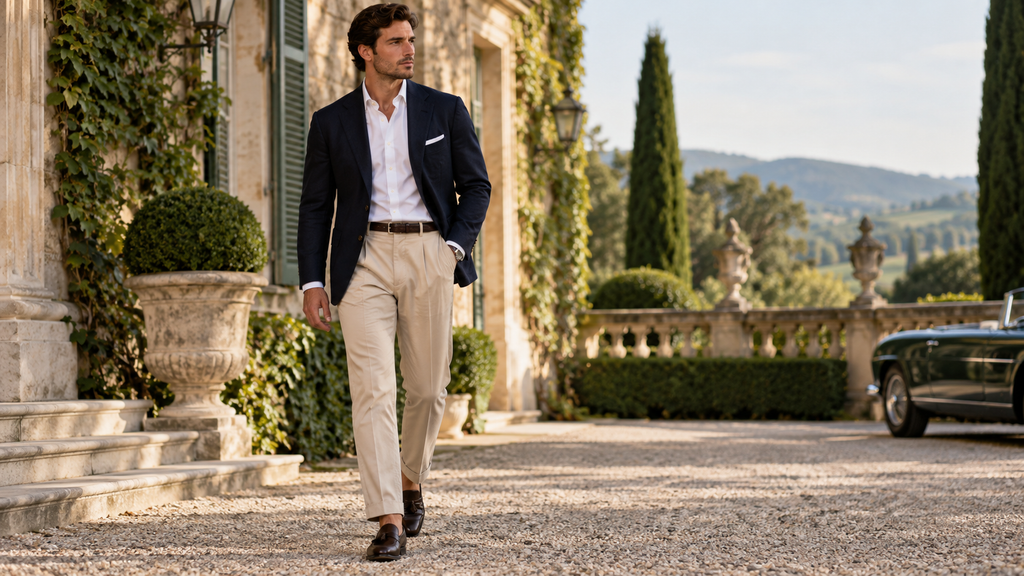
How to Build Old Money Outfits
The easiest formula is to begin with one classic foundation and add contrast through texture or proportion.
For men
Look 1: Everyday classic
Navy knit polo + beige chinos + brown loafers + leather belt.
Look 2: Smart casual
White Oxford shirt + gray trousers + navy blazer + dark brown loafers.
Look 3: Weekend
Cable-knit sweater + white T-shirt + straight-leg denim + suede loafers.
Look 4: Warm weather
Linen shirt + tailored cream trousers + loafers + understated watch.
For women
Look 1: Minimal
Cream knit sweater + tailored trousers + loafers + structured handbag.
Look 2: Preppy
White shirt + pleated midi skirt + cardigan + loafers.
Look 3: Resort-inspired
Linen shirt + wide-leg trousers + leather sandals + simple jewelry.
Look 4: Polished city look
Navy blazer + silk blouse + straight trousers + pointed flats.
Notice what these outfits have in common: none requires a recognizable luxury logo.
The impression comes from silhouette, fabric, color coordination, and finishing.
Old Money Style vs. Quiet Luxury vs. Preppy Style
These terms overlap, but they are not identical.
| Style | Main characteristic | Typical references |
|---|---|---|
| Old money style | Traditional wealth and leisure codes | Ivy, country clubs, resorts |
| Quiet luxury | Understated quality and minimal branding | Fine tailoring, premium basics |
| Preppy | Collegiate and traditional American clothing | Polos, Oxford shirts, loafers |
| Classic style | Long-lasting wardrobe staples | Tailoring, shirts, coats |
| Heritage style | Traditional craft and workwear references | Tweed, waxed cotton, leather |
Old money style is primarily a cultural aesthetic.
Quiet luxury is more about the visual expression of quality without conspicuous branding.
Preppy style has a stronger connection to collegiate clothing.
Vogue identified old-money aesthetics and stealth wealth as part of the broader wave of “core” fashion trends that became prominent on social media, while British Vogue described the aesthetic as a more obvious version of stealth wealth with classic separates and luxury associations.
In practice, one outfit can belong to all three categories.
A navy blazer, Oxford shirt, khaki trousers, and loafers could reasonably be described as preppy, old money, or quiet luxury-inspired, depending on context.
How to Wear Old Money Style Without Looking Like a Costume
This is where many attempts go wrong.
The problem is not usually the clothing itself. It is the lack of personal interpretation.
Wearing every stereotypical piece simultaneously can produce an outfit that looks like a Pinterest board rather than a wardrobe.
Instead, choose two or three recognizable elements.
For example:
Navy blazer + straight denim + loafers
is enough.
You do not need:
- Blazer
- Polo
- Cable-knit sweater over shoulders
- Designer belt
- Signet ring
- Sunglasses
- Loafers
- Silk scarf
- Gold watch
- Monogrammed bag
all at once.
The second outfit is trying to communicate the aesthetic too aggressively.
A better rule is:
Borrow the design principles, not the costume.
This also allows the style to fit different cultures and climates.
Someone living in a hot climate does not need to wear heavy wool trousers simply because they appear in classic European imagery. Linen, cotton, tropical-weight wool, lightweight tailoring, and breathable knitwear can communicate the same principles more intelligently.
Can You Create Old Money Style on a Budget?
Absolutely.
In fact, the aesthetic is unusually compatible with budget-conscious wardrobe building because its most important characteristics are not visible logos or expensive embellishments.
Prioritize:
- Fit
- Fabric
- Condition
- Color
- Construction
- Versatility
- Brand
That order matters.
A well-fitting secondhand blazer may be more useful than an expensive designer jacket that does not suit your proportions.
Thrift stores, vintage shops, outlet stores, resale platforms, and alterations can all help.
A tailor can sometimes make a significant difference to trousers, sleeves, waistlines, and jacket proportions.
This is particularly important for classic clothing because the silhouettes are relatively simple. When there are fewer visual distractions, poor fit becomes more obvious.
Common Old Money Style Mistakes
Buying logos instead of quality
A large designer logo does not automatically communicate old money.
In fact, conspicuous branding often moves the outfit toward a different fashion language.
Wearing everything oversized
Relaxed clothing can work, but oversized does not mean shapeless.
A large blazer combined with wide trousers and an oversized shirt can eliminate the visual structure that makes the outfit polished.
Balance volume.
Using only beige
The old money aesthetic is not a beige uniform.
Navy, white, gray, brown, olive, burgundy, pale blue, and restrained patterns can make the wardrobe far more interesting.
Over-accessorizing
A watch, belt, sunglasses, and one understated piece of jewelry may be enough.
Accessories should complete the outfit rather than explain it.
Ignoring shoes
Shoes can completely change the impression of an outfit.
Classic loafers, simple leather shoes, ballet flats, understated boots, and clean minimalist sneakers can all work depending on the outfit.
But footwear that is visibly worn out, excessively flashy, or stylistically disconnected can undermine the entire look.
Confusing expensive with refined
Price and refinement are not the same thing.
A garment can be expensive because of its label while having poor proportions or excessive decoration.
The old money aesthetic works best when the garment’s design is doing the talking.
Why Old Money Style Became Popular Again
The recent popularity of old money style is closely connected to social media’s fascination with named aesthetics.
The aesthetic became especially visible through TikTok, Instagram, Pinterest, celebrity styling, films, television, and nostalgia for earlier forms of dress.
GQ’s 2025 analysis connected the trend to images of figures such as JFK Jr. and Carolyn Bessette-Kennedy, classic Ralph Lauren advertising, The Talented Mr. Ripley, and broader nostalgia for Ivy and prep culture. It also notes that younger consumers are using the aesthetic partly as a kind of visual character or identity.
There is another reason the look works particularly well online: it photographs clearly.
A navy blazer, cream sweater, loafers, tennis whites, sunglasses, and coastal setting immediately communicate a story.
The aesthetic is therefore partly clothing and partly visual world-building.
That does not make it meaningless. It simply explains why social media often presents a much more polished and theatrical version than everyday classic dressing actually looks.
The style also emerged alongside renewed interest in quiet luxury. Vogue’s coverage of understated dressing linked the aesthetic to simple garments, minimalism, and the idea that an uncomplicated outfit can appear sophisticated through proportion and styling rather than decoration.
Is Old Money Style Still Relevant in 2026?
Yes, but its most useful form is changing.
The strongest contemporary interpretation is moving away from literal social-media cosplay and toward classic wardrobe design.
Recent fashion coverage continues to describe old money aesthetics in terms of Ivy influences, traditional silhouettes, quality materials, restrained color, and understated luxury.
That evolution is important.
Instead of asking:
“How can I look like old money?”
a better question is:
“Which elements of classic dressing actually suit my lifestyle?”
For one person, that might mean a navy blazer and loafers.
For another, it could mean relaxed linen trousers, a fine knit, leather sandals, and a simple bag.
Someone else might prefer pleated trousers, an Oxford shirt, and a vintage watch.
The underlying principle remains the same: buy fewer pieces, understand proportion, choose materials carefully, and avoid unnecessary visual noise.
There is also growing awareness that the phrase “old money” carries class and exclusivity associations. That history should not be erased simply because the aesthetic has become a social-media trend. Architectural Digest has discussed both the aesthetic’s association with traditional privilege and the ways contemporary designers and communities have reinterpreted prep culture.
That makes a more inclusive interpretation of classic style particularly valuable.
You do not need to reproduce an imagined wealthy lifestyle to appreciate good tailoring, beautiful textiles, or traditional wardrobe pieces.
A Practical Old Money Wardrobe Formula
If you are starting from scratch, keep the first wardrobe simple.
Foundation
Choose:
- One navy blazer
- One white shirt
- One pale-blue shirt
- One neutral knit
- One pair of tailored trousers
- One pair of chinos
- One pair of dark jeans
- One pair of loafers
- One simple leather belt
- One versatile outer layer
Then build around these pieces.
The advantage is that almost every item can interact with several others.
That is a sign of a well-designed wardrobe.
Rather than buying clothing according to a trend, think like a designer:
Does this piece add a new silhouette, fabric, color, or function?
If it does not, you may not need it.
The Role of Accessories
Accessories should be deliberately restrained.
Watches
A simple analog watch works well because it complements the outfit without dominating it.
Belts
Leather belts should generally relate to the footwear rather than compete with it.
Sunglasses
Classic shapes such as understated wayfarer-style, aviator-inspired, or softly rounded frames can work, depending on the wearer.
Scarves
Silk scarves can introduce pattern without overwhelming a neutral outfit.
Bags
Structured leather bags, simple totes, understated shoulder bags, and classic briefcases can support the aesthetic.
The common thread is not price.
It is visual discipline.
Sustainability and Old Money Style
There is an interesting sustainability lesson hidden inside this aesthetic.
The best version of old money style encourages wardrobe longevity.
If you purchase a navy blazer that works for five years rather than a highly trend-driven jacket that becomes difficult to wear after one season, the classic approach can naturally reduce wardrobe turnover.
But classic-looking clothing is not automatically sustainable.
A cheap garment produced with poor materials and poor construction can still create waste even if it resembles a timeless design.
The more useful sustainability principles are:
- Buy fewer pieces
- Wear garments repeatedly
- Repair when practical
- Choose durable fabrics
- Consider secondhand clothing
- Avoid unnecessary trend purchases
- Look for versatile garments
- Care for shoes and knitwear properly
The result is a wardrobe that becomes more personal with time rather than constantly being replaced.
The Most Important Rule of Old Money Style
The most important rule is simple:
Do not dress to prove that you have money. Dress as though you understand clothes.
That distinction changes everything.
It shifts attention from labels to fabric, from price to construction, from trends to proportion, and from imitation to personal style.
A beautifully fitting pair of trousers, a good shirt, polished shoes, and a well-chosen jacket can say more than an outfit covered in recognizable branding.
Old money style is therefore best understood not as a literal uniform of wealthy people but as a modern fashion shorthand for classic silhouettes, understated luxury, heritage references, and visual restraint.
Once you understand those principles, you can borrow from the aesthetic without becoming trapped by it.
FAQ
What exactly is old money style?
Old money style is a fashion aesthetic inspired by traditional elite, Ivy League, preppy, country, and resort dressing. It generally emphasizes classic silhouettes, restrained colors, quality-looking fabrics, and minimal visible branding.
Is old money style the same as quiet luxury?
Not exactly. They overlap heavily, but old money style has stronger associations with heritage, preppy clothing, leisure, and traditional social codes. Quiet luxury focuses more specifically on understated quality and the absence of conspicuous branding.
What colors are best for old money outfits?
Navy, white, ivory, beige, camel, gray, brown, olive, pale blue, and burgundy are especially versatile. You can also use traditional brighter preppy colors as controlled accents.
Can old money style be affordable?
Yes. Fit, fabric, proportion, grooming, and color coordination matter more than wearing expensive labels. Secondhand clothing and tailoring can be particularly useful.
What shoes fit old money style?
Loafers are one of the clearest choices, but simple leather shoes, suede loafers, ballet flats, understated boots, boat shoes, and clean minimalist sneakers can also work depending on the outfit.
Is old money style only for wealthy people?
No. The contemporary fashion aesthetic is a visual interpretation of classic clothing. You can adopt its design principles regardless of income or background.
What is the difference between old money and preppy style?
Preppy style is more directly connected to American collegiate clothing and its associated culture. Old money style borrows from prep but also includes country, resort, tailoring, and European heritage references.
How can I avoid looking like I’m wearing an old money costume?
Do not combine every stereotypical element at once. Start with classic basics, maintain good proportions, choose comfortable fabrics, and incorporate the aesthetic into your existing personal style.
Bilkul — article ke end mein yeh strong, natural conclusion add kar dein:
Conclusion
Old money style is ultimately less about wealth and more about how clothing is chosen, fitted, combined, and worn. Its strongest elements—tailored trousers, classic shirts, knitwear, loafers, structured outerwear, restrained colors, and quality textures—have remained relevant because they are practical as well as visually refined.
The modern interpretation does not require expensive designer labels or a wardrobe built entirely around beige and navy. A well-fitting blazer, a good pair of trousers, clean leather shoes, and a few versatile shirts can create the foundation. From there, personal taste, climate, lifestyle, and proportion should determine how the style develops.
The most successful approach is to take inspiration from the tradition without trying to imitate an imagined wealthy lifestyle. Focus on fit, fabric, balance, simplicity, and longevity. Those principles make old money style adaptable to everyday wardrobes, whether you prefer classic menswear, feminine tailoring, relaxed resort dressing, or a modern minimalist look.
In the end, the appeal of old money style comes from its restraint. It does not need to announce itself. When the clothes fit well, the colors work together, the materials have character, and the accessories are considered, the result feels polished without looking forced. That is what makes the aesthetic useful beyond a passing social-media trend: it provides a practical framework for building a wardrobe that can remain stylish long after individual fashion trends have changed.