1940’s women’s fashion trends were shaped by one of the most disruptive periods of the twentieth century. The decade began with elegant prewar influences, moved into practical clothing during World War II, and ended with a dramatic return to elaborate femininity through Christian Dior’s 1947 New Look.
That transformation is what makes 1940s fashion so interesting. It was not one fixed aesthetic. A woman wearing a tailored utility suit in 1943 could look very different from a woman wearing a full-skirted Dior-inspired dress in 1949.
The difference came from changing circumstances. War production affected textiles, clothing regulations limited fabric use, and millions of women entered workplaces that demanded practical garments. At the same time, designers continued to experiment with proportion, tailoring and construction. After the war, fashion began moving in another direction, eventually producing the dramatic waist-and-skirt silhouette associated with Dior.
Understanding 1940’s women’s fashion trends therefore requires looking beyond vintage dresses. The decade reveals how fashion responds to economics, technology, work, culture and changing ideas about femininity.
Why the 1940s Changed Women’s Fashion
World War II had an immediate effect on clothing production. In the United States, the War Production Board issued Regulation L-85 in 1942, restricting the use of materials needed for the war effort. The regulations affected natural fibers, garment dimensions, decorative details and even certain construction elements. Nylon, for example, was redirected toward military applications, including parachutes.
This meant that fashion design could no longer operate simply around novelty.
Designers had to think carefully about fabric consumption. Garments became more economical, decorative excess was reduced, and construction became increasingly important. The result was a style that could still look polished without depending on large quantities of material.
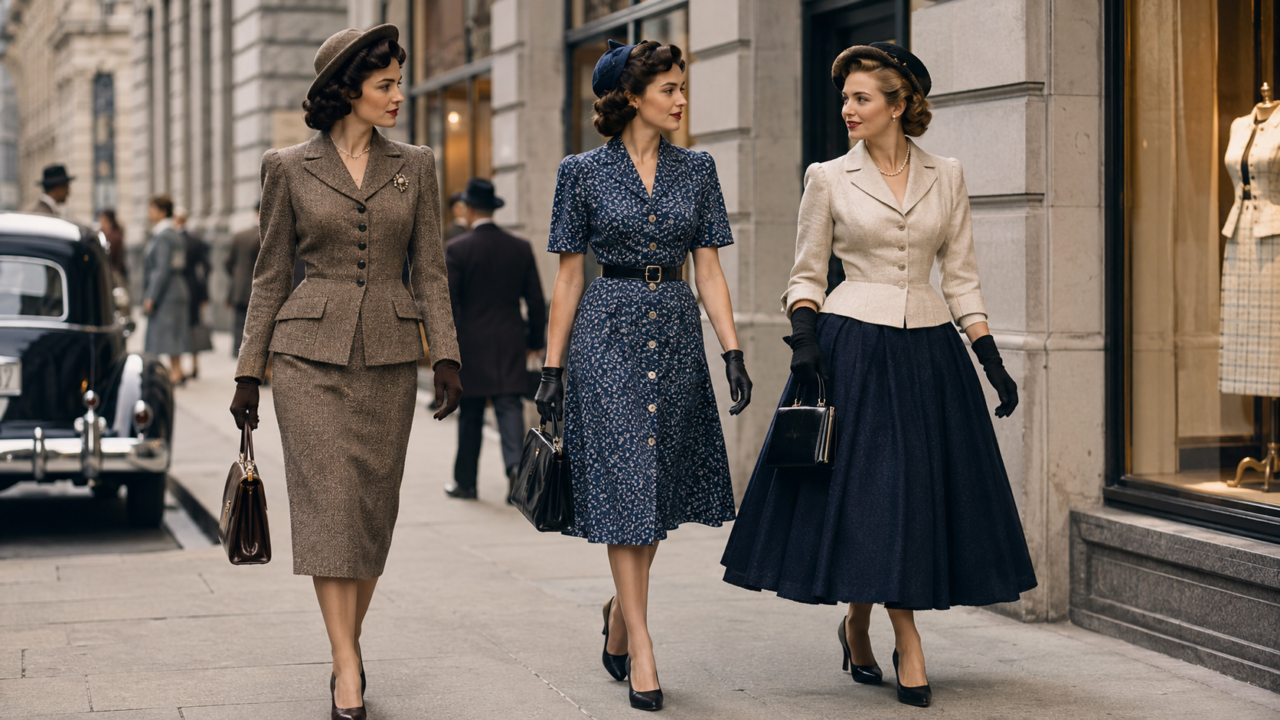
The Museum at the Fashion Institute of Technology describes wartime women’s clothing as having a strong, practical character. The silhouette frequently featured broad shoulders, a defined waist, calf-length hems and relatively narrow skirts.
The social role of women was changing at the same time.
Women worked in factories, offices, farms, transportation and other areas connected to wartime production. Clothing had to accommodate movement and work. The Smithsonian records government-designed garments for female agricultural and industrial workers that included coveralls, slacks, one-piece suits and practical pockets.
Fashion therefore became closely connected to function.
That does not mean women abandoned elegance. Instead, elegance was often expressed through proportion, tailoring, grooming and clever styling rather than excessive decoration.
This is one of the most important characteristics of 1940s fashion: practicality did not eliminate fashion; it changed where fashion lived.
The Wartime Silhouette: Strong Shoulders and Defined Waists
The wartime female silhouette was immediately recognizable.
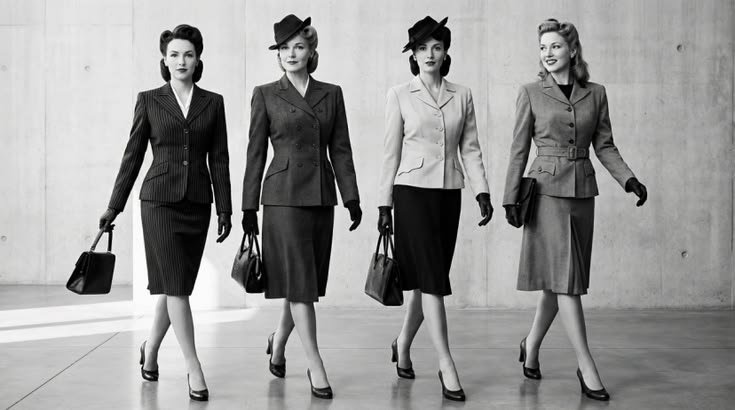
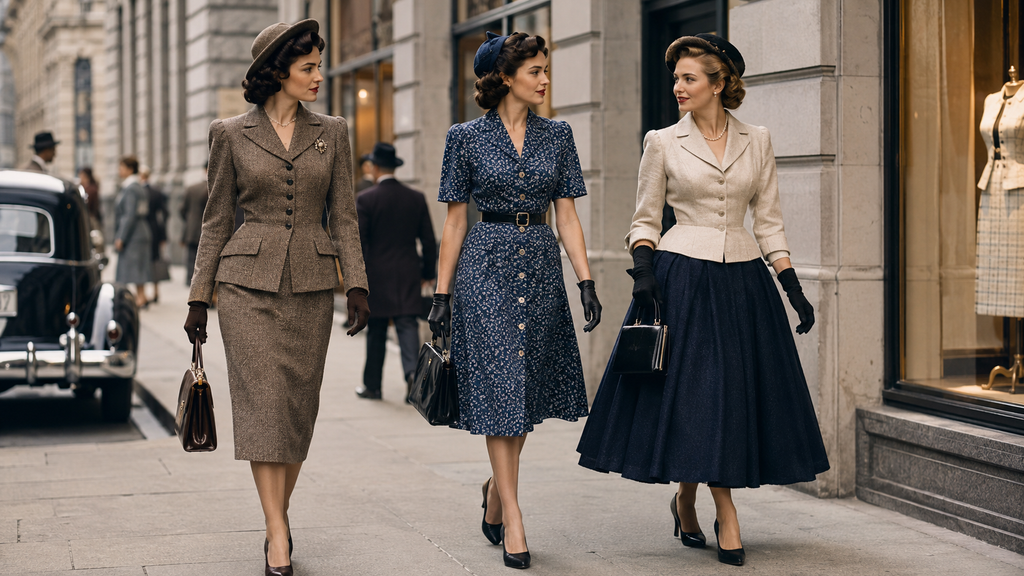
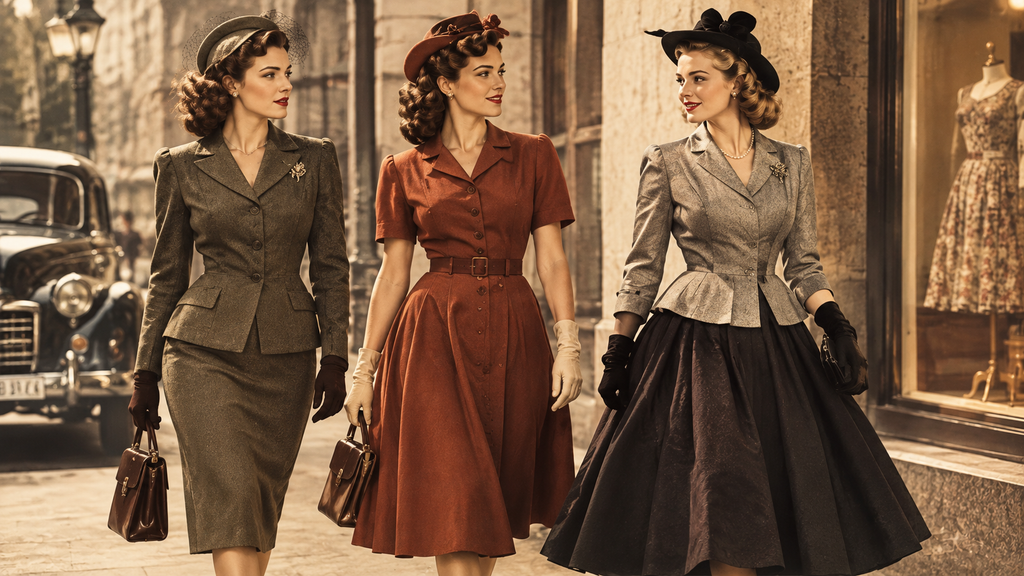
One of its strongest visual features was the shoulder. Jackets and dresses often created a broader upper body, sometimes with structured shoulders or padding. This produced a confident, almost architectural shape.
The waist remained important, but the relationship between shoulder and waist changed. Instead of the soft, flowing proportions associated with some 1930s styles, wartime clothing could appear sharper and more tailored.
The resulting shape was approximately:
broad shoulders → defined waist → narrow or moderately straight skirt
This proportion also had a practical advantage. A relatively narrow skirt used less fabric than the voluminous skirts that would become popular after 1947.
Tailoring became especially valuable because it could create visual structure without relying on extensive ornament.
A simple wool suit could appear sophisticated through:
- A sharply defined shoulder
- A fitted waist
- A carefully shaped lapel
- A neat collar
- Patch or flap pockets
- Strong vertical seams
- A straight or slightly tapered skirt
This is why 1940s fashion continues to interest fashion designers. The decade demonstrates how silhouette can create visual impact even when materials are limited.
Dresses, Skirts, and Everyday Women’s Clothing
The dress remained an important part of women’s wardrobes during the 1940s.
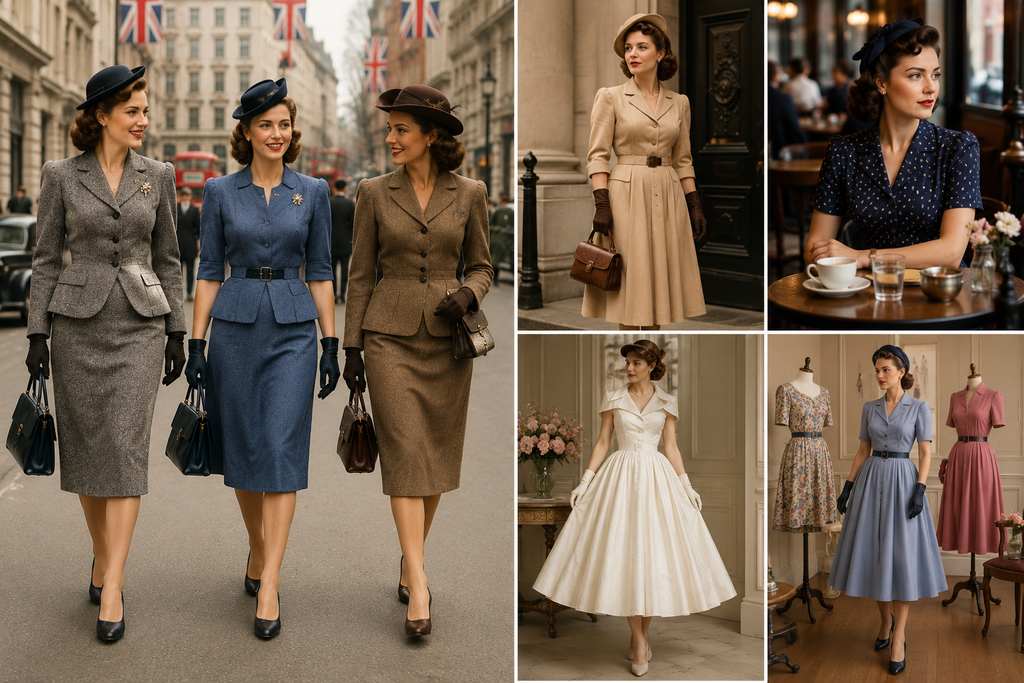
Day dresses were often practical rather than extravagant. Many used relatively simple construction and modest skirt widths. The waist could be emphasized with a belt or shaped seam, while collars, buttons and pockets provided visual interest.
Printed cotton was particularly useful for everyday clothing. Small-scale patterns could make a practical dress feel decorative without requiring elaborate construction.
Common details included:
- Shirt-style collars
- Button-front bodices
- Short or moderately long sleeves
- Defined waistlines
- Knee-to-calf-length skirts
- Belts and waist ties
- Patch pockets
- Simple pleats or gathers
- Practical fastening systems
The Smithsonian’s collection includes a 1940–45 women’s dress designed by Louella Ballerino, illustrating the range of ready-made American women’s clothing during the period.
Wartime wedding clothing also demonstrates the tension between practicality and occasion dressing. A 1945 dress in the Smithsonian collection, designed by Adrian, was worn for a wartime wedding. Although wedding dresses were exempt from Regulation L-85, the museum notes that many women avoided elaborate wedding clothing because of the circumstances and expense of wartime life.
That distinction matters.
Not every woman in the 1940s owned a glamorous formal dress. Everyday clothing was often considerably more restrained.
Women’s Suits and the Rise of Practical Tailoring
The 1940s suit became one of the decade’s strongest expressions of modern womanhood.
A women’s suit offered a useful combination of professionalism, structure and versatility. A jacket could be worn with a matching skirt or combined with other pieces, allowing a relatively small wardrobe to create multiple outfits.
The tailored suit also reflected the changing public presence of women.
Broad shoulders created authority. A defined waist retained a feminine proportion. The skirt maintained conventional dress codes while the jacket introduced a more masculine tailoring vocabulary.
This mixture produced an interesting visual balance.
The garment could borrow from menswear without simply copying it.
Claire McCardell was an important American designer during this period. The Metropolitan Museum of Art’s collection includes her 1942 suit in wool and cotton, demonstrating her contribution to American sportswear and practical clothing design.
McCardell’s work is particularly valuable for understanding the broader evolution of American fashion. Her designs often considered how clothing actually behaved on the body rather than treating the garment only as a decorative object.
That approach would become increasingly influential in American sportswear.
Trousers, Coveralls, and Women at Work
One of the most significant changes in women’s clothing during the 1940s was the increased visibility of trousers and workwear.
Women working in factories could not always wear traditional skirts safely. Loose fabric could interfere with machinery, while restrictive clothing could make physical work difficult.
Government researchers responded directly to this problem.
The Smithsonian documents USDA clothing experiments from the early 1940s that included coveralls, slacks and one-piece garments for female agricultural and industrial workers. Some designs incorporated generous pockets so women could carry objects normally kept in handbags.
This is an excellent example of fashion responding to real-world requirements.
The popular image of “Rosie the Riveter” in trousers or workwear became an important visual symbol of women participating in wartime production. But trousers were not simply a political symbol or costume. They solved practical problems.
The wider significance was that women were becoming more accustomed to clothing designed around movement.
That helped establish a foundation for the more casual American sportswear culture that became increasingly important after the war.
For modern fashion designers, this period offers an important lesson: changes in clothing often begin with changes in people’s daily lives.
Fabrics, Colors, and Wartime Restrictions
Fabric availability had a major influence on 1940s fashion.
In the United States, wartime regulation restricted the use of certain fibers and limited garment construction. Decorative features that consumed unnecessary material could be removed or reduced. The Smithsonian notes restrictions affecting skirt lengths, garment fullness, cuffs, colors and other details.
Rayon became an important substitute in many applications, while cotton and wool remained important materials.
The point was not simply that people wore “cheap fabrics.” Textile selection depended on availability, location, garment purpose and period.
A practical 1940s wardrobe might include:
- Cotton day dresses
- Wool suits
- Rayon garments
- Wool coats
- Synthetic hosiery
- Practical shoes
- Reworked or altered clothing
Color also had to operate within practical limits.
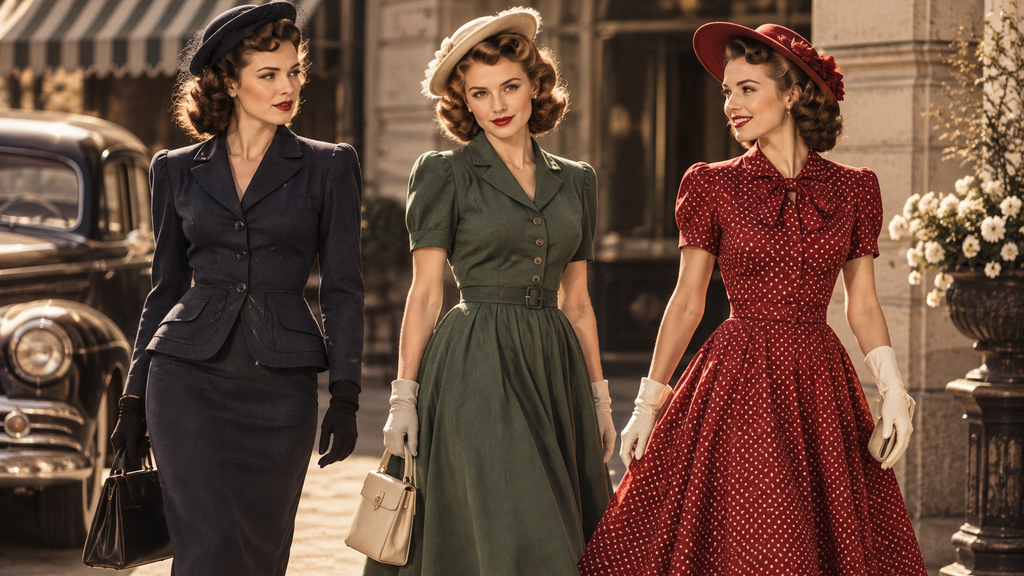
Wartime fashion frequently relied on restrained combinations and relatively conservative palettes. Navy, brown, gray, beige, olive and other muted shades could work well for suits and everyday clothing.
However, it would be inaccurate to imagine that all 1940s fashion was dull.
Prints, accessories and small decorative details could provide contrast. Eveningwear and special-occasion clothing could also be considerably more glamorous.
The important distinction is between resource-conscious fashion and colorless fashion. The two are not the same.
Accessories That Completed the 1940s Look
Accessories were especially important during the 1940s because they could transform a relatively simple garment.
When fabric and decorative materials were limited, accessories offered another way to express personality.
Hats
Hats were a significant part of many women’s public wardrobes.
A hat could add height, structure or personality to a simple suit or dress. Styles ranged from practical turbans and head coverings to more sculptural hats.
The wartime turban is particularly memorable because it combined practicality with visual interest. It could help contain hair while also creating a polished appearance.
Gloves
Gloves remained associated with formal dressing, although their importance varied according to occasion and location.
For a formal ensemble, gloves could reinforce the polished quality of the outfit.
Handbags
Small structured handbags worked well with the tailored silhouette.
A boxy or compact handbag complemented the architectural proportions of a 1940s suit. Practicality was also important, especially when women were traveling to workplaces.
Shoes
Shoes generally reflected the practical conditions of the era.
Sturdy heels, practical pumps and low-heeled styles could be easier to wear throughout the day than delicate footwear.
The wartime shortage of materials also influenced shoe construction.
Costume Jewelry
Jewelry offered another way to add interest without dramatically changing the garment.
Brooches, earrings, necklaces and bracelets could provide a focal point against a simple dress or suit.
The broader styling principle is worth remembering: when the garment is restrained, accessories can carry more of the visual personality.
Beauty, Hairstyles, and the Complete Silhouette
1940s fashion cannot be understood through clothing alone.
Hair and makeup completed the overall proportion.
Women’s hairstyles often emphasized controlled volume, curls and carefully arranged shapes. Victory rolls became particularly associated with wartime imagery, although they were only one element of a much broader range of hairstyles.
Makeup also played an important cultural role. During wartime, cosmetics and grooming could help maintain a sense of normality and femininity.
This creates an interesting contrast.
Clothing could be highly practical while beauty remained carefully constructed.
A woman might wear a relatively simple utility-inspired dress but combine it with styled hair, lipstick, earrings and a hat. The resulting appearance was not purely utilitarian.
This is another reason the 1940s should not be reduced to “wartime clothing.”
The period’s visual language was created through the relationship between garment, hair, face and accessories.
From Wartime Utility to Dior’s New Look
The biggest shift in late-1940s women’s fashion came in February 1947, when Christian Dior presented his first collection.
The collection was officially called the Corolle line, but fashion editor Carmel Snow famously popularized the name “New Look.” The silhouette contrasted sharply with the restrained clothing of the war years.
Dior’s shape featured:
- Rounded or softened shoulders
- A dramatically defined waist
- Emphasized hips
- Long, full skirts
- Significant fabric volume
- A strongly feminine proportion
The Metropolitan Museum of Art’s 1947 Dior dress demonstrates the construction behind the silhouette. Its exaggerated hipline was created using haircloth interlining, while the full pleated skirt produced the substantial volume characteristic of the collection.
The change was dramatic because women had spent years living with material restrictions.
A skirt requiring substantial quantities of fabric represented almost the opposite philosophy.
Why the New Look Was So Dramatic
The New Look was not simply a new color or neckline.
It changed proportion.
During the war, a typical tailored silhouette could emphasize the shoulders and create a narrow lower body. Dior reversed that visual emphasis.
The upper body became more delicate, the waist became smaller, and the skirt expanded dramatically.
In simplified design terms:
Wartime silhouette:
Broad shoulder + defined waist + narrow skirt
New Look silhouette:
Soft shoulder + tiny waist + full skirt
This was more than a fashion adjustment. It was a statement about what clothing could look like after years of constraint.
But the New Look was also controversial.
For women accustomed to practical wartime clothes, extremely full skirts could appear wasteful or inconvenient. FIT’s Fashion History Timeline notes that some styles required very large quantities of fabric and that the silhouette generated criticism precisely because of the material conditions of the period.
The New Look Was Not the Whole 1940s
This distinction is essential.
Searches for “1940’s women’s fashion trends” often produce images of women wearing huge skirts and tiny waists. Those images are historically real, but they represent mainly the late-1940s direction.
The early and middle years were dominated by wartime conditions.
Dior’s 1947 collection changed the direction of fashion, but the transition was not instantaneous everywhere. Britain, for example, continued clothing rationing until 1949.
Therefore, an authentic representation of the decade should distinguish between:
1940–1942:
Strong prewar tailoring mixed with emerging wartime restrictions.
1942–1945:
Utility clothing, controlled fabric use, practical suits, workwear and simplified silhouettes.
1945–1946:
A transitional period in which fashion began moving away from wartime austerity.
1947–1949:
Dior’s New Look and increasingly elaborate feminine silhouettes, alongside continued American interest in practical sportswear.
This timeline is far more accurate than presenting one “1940s look.”
American Sportswear and the Late-1940s Direction
While Parisian couture was moving toward increasingly feminine silhouettes, American designers were developing another direction.
American sportswear emphasized practicality, comfort and movement. Designers such as Claire McCardell demonstrated that functional clothing could also have sophisticated design.
The Metropolitan Museum’s collection includes McCardell garments from the early and late 1940s, including a 1943 cotton dress and a 1948 cotton dress.
This created an important tension within postwar fashion.
Paris was associated with couture and dramatic silhouettes.
American sportswear was increasingly associated with practicality and modern everyday life.
Both directions influenced later fashion.
The couture tradition contributed to the highly shaped feminine dresses and formalwear that would characterize much of the 1950s. American sportswear, meanwhile, helped establish ideas of casual dressing and functional design that became increasingly influential in the decades that followed.
How 1940s Women’s Fashion Influences Fashion Design Today
The most useful way to study historical fashion is not simply to copy it.
The 1940s provides several design lessons that remain relevant.
Proportion Can Create an Entire Identity
The difference between the wartime silhouette and the New Look demonstrates how dramatically clothing can change simply through proportion.
A designer does not necessarily need an unusual print or elaborate embellishment. Changing shoulder width, waist placement or skirt volume can transform the character of an entire collection.
Constraints Can Produce Creativity
Wartime rationing forced designers to reconsider fabric consumption.
Limited resources encouraged careful cutting, simpler construction and more thoughtful use of decoration.
That idea has obvious relevance to contemporary sustainable fashion.
Modern designers concerned with waste can study historical examples of efficient pattern cutting and garments designed around limited resources.
Function Can Influence Aesthetic
The rise of women’s workwear demonstrates that practical requirements can eventually influence fashion itself.
Pockets, trousers, durable fabrics and movement-friendly designs were not originally introduced simply as aesthetic trends. They responded to changing activities.
Once those garments became culturally visible, they influenced the wider vocabulary of women’s clothing.
Historical Fashion Is More Diverse Than Its Most Famous Image
The 1940s are often represented by a narrow selection of glamorous dresses.
But real wardrobes were more complicated.
Women wore work clothes, suits, day dresses, coats, separates, uniforms, practical shoes and formalwear.
For fashion students and designers, this broader view is much more useful than copying a single vintage photograph.
How to Recreate an Authentic 1940s-Inspired Look
If the goal is to dress with 1940s influence today, authenticity comes from combining several details rather than wearing every recognizable vintage element at once.
For a wartime-inspired outfit, start with a tailored jacket featuring defined shoulders and a fitted waist. Pair it with a knee- or calf-length straight skirt, practical pumps and a structured handbag.
For a 1940s day-dress look, choose a cotton or rayon-inspired dress with a defined waist, modest neckline, short sleeves and a restrained print. Add a belt, simple earrings and a small handbag.
For a late-1940s look, emphasize the New Look’s proportions. Look for a fitted waist and fuller skirt, but avoid assuming that every 1940s outfit required an enormous ball-gown silhouette.
For a 1940s workwear interpretation, trousers, a tucked-in blouse, practical shoes and a headscarf can create the visual idea without turning the outfit into a costume.
The key is proportion.
A modern outfit can feel historically informed without looking like theatrical dress.
Common Misconceptions About 1940s Women’s Fashion
Myth: Every woman wore a New Look dress.
The New Look emerged in 1947, so it cannot accurately represent the entire decade.
Myth: 1940s clothing was always glamorous.
Everyday clothing during the war was often practical and resource-conscious.
Myth: Women did not wear trousers before the 1940s.
Women had worn trousers before the decade, but wartime employment greatly increased the visibility and practical importance of women’s trousers and workwear.
Myth: Wartime clothing was simply boring.
Designers used tailoring, proportion, prints, collars, belts, accessories and construction details to maintain visual interest.
Myth: Dior invented every element of the New Look from nothing.
The New Look was a dramatic reinterpretation of earlier ideas rather than a completely disconnected invention. FIT’s Fashion History Timeline notes that its forms drew on prewar and historical influences.
Myth: 1940s fashion looked the same everywhere.
Fashion varied considerably by country and circumstance. Wartime France, Britain and the United States had different experiences of restrictions, production and fashion culture.
Conclusion
1940’s women’s fashion trends tell a story of adaptation.
At the beginning of the decade, women’s clothing still carried the elegance and tailoring of the prewar period. As World War II intensified, fabric restrictions and changing employment transformed the wardrobe. Strong shoulders, fitted waists, narrow skirts, practical suits, trousers and workwear became important expressions of a society operating under pressure.
Then the direction changed.
Christian Dior’s 1947 New Look brought fuller skirts, smaller waists and a renewed emphasis on elaborate femininity. The dramatic amount of fabric used by the silhouette made it particularly striking after years of restrictions. Yet it was only one part of the late-1940s story. American sportswear continued to develop a more practical approach to modern dressing.
The lasting lesson of the decade is not simply that 1940s clothes looked a certain way. It is that fashion responds to circumstances.
Materials influence design. Work influences silhouettes. Technology changes textiles. Social expectations shape clothing. And designers reinterpret all of those pressures into something visually meaningful.
That makes the 1940s more than a vintage reference. It is a valuable case study in fashion design itself.
For anyone studying historical fashion, designing contemporary collections or simply trying to understand why certain silhouettes return, the decade offers a particularly rich lesson: fashion becomes most revealing when you examine not only what people wore, but why those clothes made sense at that moment in history.
FAQ
What were the main 1940’s women’s fashion trends?
Major trends included strong shoulders, fitted waists, tailored suits, practical day dresses, narrow skirts, trousers and workwear during the war. After 1947, fuller skirts and more defined hourglass silhouettes became increasingly influential through Dior’s New Look.
What dresses did women wear in the 1940s?
Women commonly wore practical day dresses with defined waists, collars, buttons, belts and calf-length skirts. Evening and special-occasion dresses could be considerably more elaborate.
What did women wear during World War II?
Women’s wartime wardrobes included tailored suits, utility dresses, practical skirts, blouses, trousers, coveralls and other functional clothing. Clothing regulations in countries such as the United States affected fabric use and garment construction.
Did women wear pants in the 1940s?
Yes. Women’s trousers and coveralls became particularly important for factory, agricultural and other physical work during World War II. Smithsonian records document government-designed work garments for female workers.
What was the 1947 New Look?
Christian Dior’s New Look was a highly feminine silhouette featuring a defined waist, emphasized hips and a full, relatively long skirt. Dior’s first collection was officially called the Corolle line.
What fabrics were common in 1940s women’s clothing?
Cotton and wool remained important, while rayon and other synthetic materials were used in various garments. Wartime restrictions affected the availability and use of textiles, particularly in the United States.
How can I dress in a 1940s style without looking like I’m wearing a costume?
Choose one or two historically inspired elements—such as a defined waist, structured shoulders, a vintage-inspired dress or a headscarf—and combine them with contemporary basics. Proportion usually creates a stronger historical reference than excessive accessories.
Was all 1940s fashion inspired by Dior?
No. Dior’s influence began in 1947, while much of the decade had already been shaped by wartime conditions. American sportswear and practical clothing continued to develop alongside the return of couture glamour.